
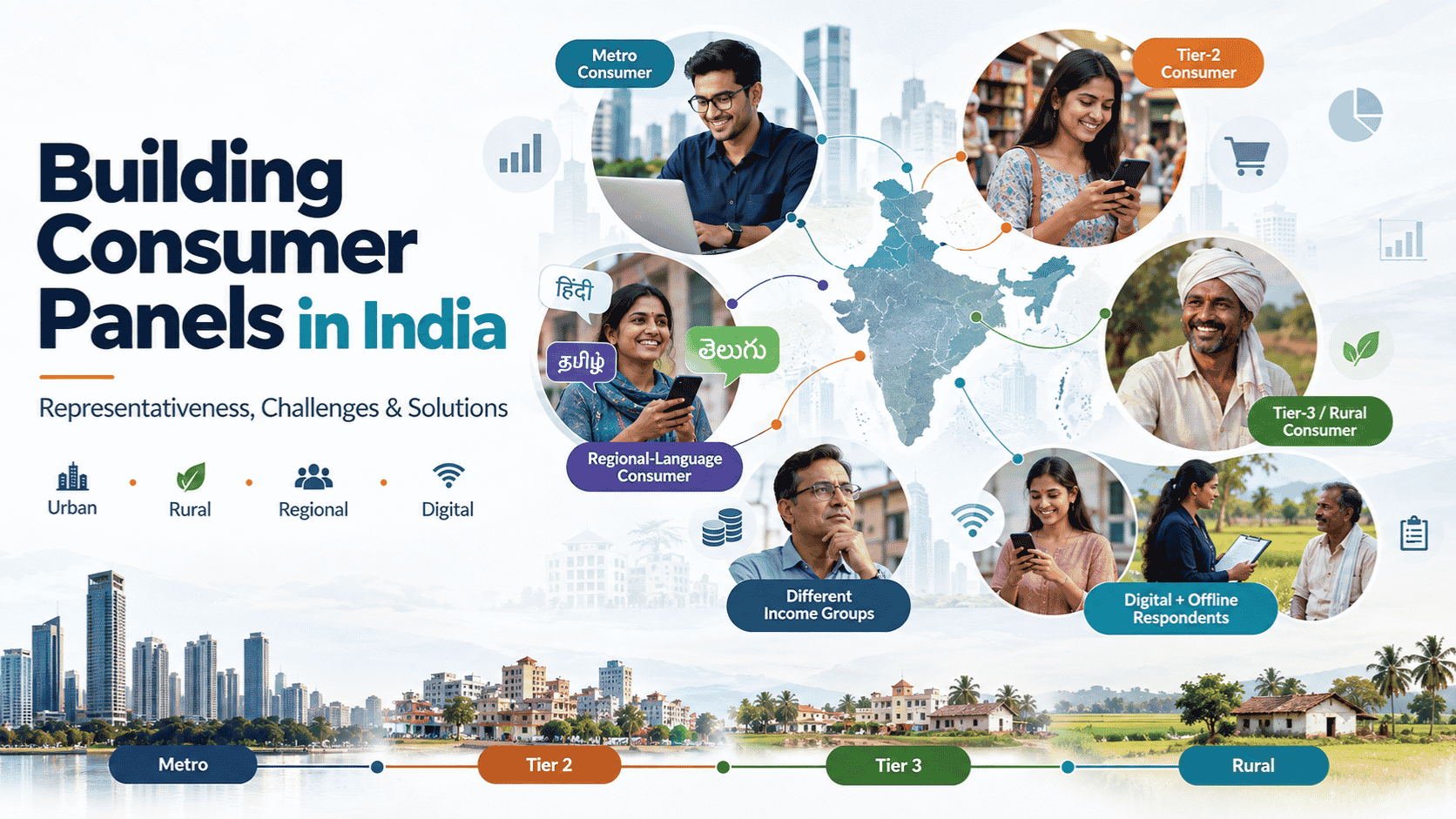
You're launching in India. The market's huge 1.4 billion people, 450+ million digital users, an emerging middle class spending like never before. But here's what nobody tells you: the consumer panel you built for the US won't work here.
Last year, a global pharma brand ran a concept test on an "India panel" assembled through app downloads and online recruitment. High purchase intent across metros. They launched confidently. Three months later, sales tanked outside major cities. When they dug in, they found their panel had massively over-represented urban, English-speaking, tech-comfortable consumers and missed 70% of their actual buying population.
This happens more than you'd think. Because India's online panel research landscape is fundamentally different from the West not just in size, but in structure, bias, and what representativeness actually means.
The India Panel Problem: It's Not Just Geography
When we talk about panel representativeness in India, we're not just talking about Delhi vs Bangalore. We're talking about a country where:
- 33% of the population doesn't own a smartphone
- Regional language speakers outnumber English speakers 7:1, yet 95% of online panels are English-only
- Digital adoption is wildly uneve a housewife in Pune has daily internet; a farmer in a nearby village doesn't
- Income segmentation is extreme someone earning ₹2 lakh/year buys at kirana stores; someone earning ₹20 lakh buys at malls. They're different consumers.
Most commercial online panels research in India were built through app and website recruitment starting in 2015-2018. Translation: your "representative" panel consists of people who:
- Found the app or website (organically or through ads)
- Owned a smartphone
- Could read English
- Had time to take surveys
The bias is obvious. You're missing everyone else. One research ops leader at a large FMCG company put it bluntly: "Our panel showed 62% brand awareness for a detergent. Actual market awareness was 28%. We launched thinking we had a hit."
What "Representativeness" Actually Means in India
In developed markets, representativeness = demographic matching (age, gender, income, region) + data weighting. You're mostly done.
India is different. Representativeness here requires:
Digital Accessibility Does your panel include people who aren't daily smartphone users? If 100% of responses came via mobile, you've excluded a real segment of your market.
Language Accessibility Can you reach Hindi, Tamil, Telugu, Kannada, and Marathi speakers or just English? A snacks brand selling ₹5 packets in tier-2 towns needs those buyers, not English-fluent Instagrammers.
Geographic Depth Rural India and tier-2 cities are where growth is happening. You need real representation there, not token responses.
Category Alignment Someone who regularly takes luxury fashion surveys won't answer mass-market questions like a typical buyer would. Your panel needs to match the actual consumer category, not just demographics.
The Three Biggest Challenges (And Why They Matter)
Challenge 1: Urban Over-Representation
About 65% of commercial online panels concentrate in metros (Delhi, Mumbai, Bangalore, Hyderabad, Chennai). The other 35% scatter across 20,000+ towns. A refrigerator brand needs urban India. A rice brand? That buyer lives in tier-2 and tier-3 cities. If your panel is 75% metros, you're missing your actual customer.
Challenge 2: Language Bias
Most online panels default to English. This isn't a small skew it's massive. A regional beauty brand tested a face cream concept. English panel in 5 metros: 48% purchase intent. Same concept, translated and culturally adapted, tested with regional-language consumers in smaller towns: 31% intent. That 31% was real. The 48% was artificial.
Challenge 3: Income Segmentation
Lower-income consumers in India take more surveys (cash incentive). But they answer differently. Someone earning ₹1.5 lakh/year approaches price questions completely differently than someone earning ₹8 lakh/year. Weighting data can't fix a fundamentally skewed base sample.
How to Build a Panel That Actually Works for India
Step 1: Know Your Actual Market
Before building or buying, answer:
- Which income tiers buy my product?
- Which states/regions matter?
- What language do my customers speak at home?
- How digitally active are they really?
A luxury brand targeting HNIs? English-weighted metros work. An FMCG brand selling into rural India? Different story entirely.
Step 2: Mix Your Recruitment Sources
Single-platform bias is real. If you only recruit through apps and websites, you get digital natives, period. Add:
- Door-to-door recruitment (captures non-digital populations)
- SMS-based panels (reaches basic phone users)
- Community partnerships (local women's groups, shopkeeper networks)
It's messier than clicking "launch panel." But it catches the real market.
Step 3: Diagnose Your Bias
Ask questions that reveal it:
- "How many hours daily do you use the internet?"
- "What's your primary language at home?"
- "Do you shop online, in stores, or both?"
- "How many surveys have you taken before?"
Survey veterans answer differently than first-timers. Someone on their 5th phone answers differently than their 1st. You need to see these distributions.
Step 4: Layer In Offline Reality
The strongest panels combine online data with census data, telecom patterns, or actual purchase records. If you have retail presence, match your panel against real store traffic. If you're new to market, use census data to spot blind spots.
Step 5: Adapt, Don't Translate
"Premium personal care products" means different things in Mumbai vs Nashik. Translate the language, yes. But adapt the scenarios, price points, and category examples to fit local contexts.
Real-World Example: Getting It Right
A global snacking brand tested a new product line for India. Instead of buying access to a standard panel, they invested 8 weeks to build one properly:
- Base panel: 2,000 respondents across 15 cities (including tier-2 and tier-3)
- Offline recruitment: 300 people in small towns (via local shopkeepers)
- Stratification: Income, language, and shopping channel
- Testing approach: Concept questions in Hindi, Tamil, and English
- Weighting: Matched to actual India income and language distribution
Results: 28% high intent, 45% medium, 27% low intent.
Six months post-launch, actual sales matched that distribution perfectly. The panel wasn't massive. It was representative.
What Really Matters
Building a consumer research panel in India isn't about getting big numbers fast. It's about getting the right people urban and rural, English and regional, digital and offline. It takes longer. It costs more than buying access to an off-the-shelf panel. But the difference between a biased panel and a representative one is launch-day clarity vs launch-day blindness.
If you're entering India, don't skip this. Because representativeness isn't a box to check. It's the difference between understanding your market and guessing.
Book a call: 15-min strategy session with our India research lead. We'll walk through your specific market and show you what representative actually looks like for your category.
 Market Research for Starting a Business: What to Do Before You Invest
  Market Research in Pharmaceutical Industry: How Pharma Companies Use It
  International Market Research Fieldwork: A Complete Guide for Multi-Country Studies