

International market research fieldwork is the hands-on part of a multi-country study: adapting the questionnaire, recruiting the right respondents in each market, collecting the data, and checking its quality before it reaches you. Done well, it gives you results you can compare across countries with confidence. Done badly, it gives you numbers that look neat and mislead.
If you're planning international market research across several countries, this guide covers how fieldwork works, where studies usually go wrong, and how to choose the right partner.
What does international market research fieldwork include?
Fieldwork is everything between "the questionnaire is approved" and "the data is delivered." In a multi-country study, that usually means:
- Questionnaire adaptation: translation and cultural checks so each question means the same thing in every market
- *Sampling and quotas: deciding who to interview in each country and how many
- Respondent recruitment: finding and screening the right people
- Data collection: online surveys, phone interviews, or moderated discussions
- Quality control: checks during and after fieldwork
- Coordination: keeping timelines and standards aligned across countries
- Data delivery: clean, consistent files and tables
Strategy, analysis and reporting sit on either side of this. Fieldwork is the part where small mistakes quietly damage the whole project.
How multi-country research differs from single-country research
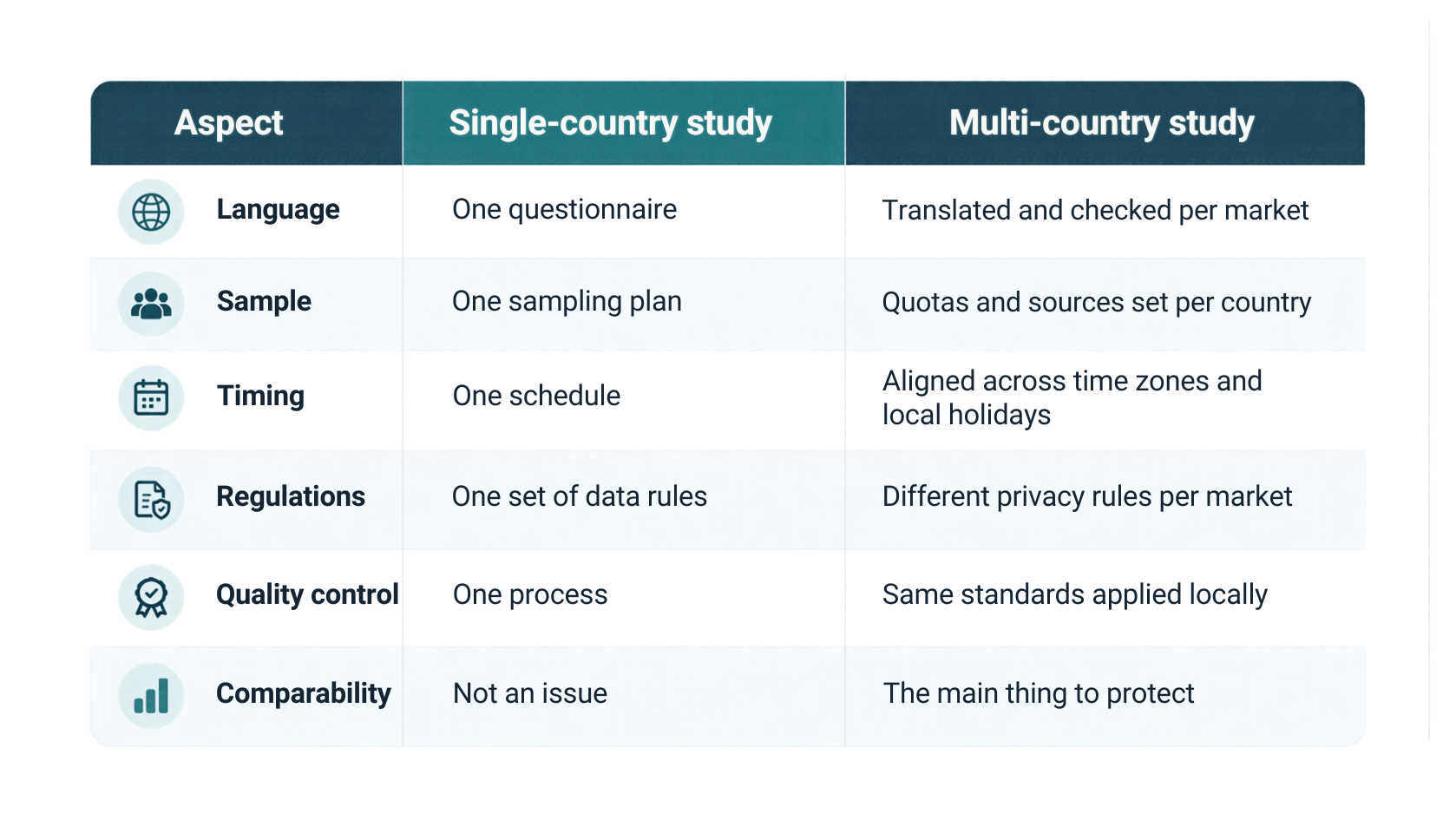
Running the same survey in five countries is not five times one survey. It's a different job.
The key word is comparability. If differences in results come from how the study was run rather than from real market differences, the findings are not useful.
Which methods work for multi-country data collection?
The method depends on the audience and the question. Most multi-country data collection uses one or more of these:
International quantitative research
- Online surveys (CAWI) are fast and cost-effective where internet access is good. Good for brand tracking, concept tests and large samples.
- Phone interviews (CATI) suit markets or audiences that are harder to reach online, and longer or more structured conversations. See our guide on CATI vs CAWI.
- Online panels let you reach defined groups quickly. Read more in What is Panel Research?
International qualitative research
- In-depth interviews work well for experts, senior decision-makers and sensitive topics.
- Online or in-person focus groups suit idea and message testing.
- Local-language moderation matters a great deal here. A moderator who isn't a native speaker can miss meaning.
Many studies combine them: qualitative research first to understand what matters, then a quantitative survey to measure it.
If you need either, our Quantitative Research and Qualitative Research teams can scope it with you.
How a multi-country study runs, step by step
- Agree one research objective. Every country should be answering the same question.
- Check feasibility market by market. Can you actually reach this audience in each country, and in what numbers?
- Set sample and quotas per country. Keep definitions consistent, even if the numbers differ.
- Translate and adapt the questionnaire. Use proper translation and review, not just machine output.
- Pilot test. Run a small soft launch in each market to catch confusing questions.
- Launch fieldwork in sync. Similar timing reduces outside events skewing results.
- Monitor quality while fieldwork runs. Don't wait until the end.
- Clean, merge and deliver data. One consistent structure across countries.
Skipping step 5 is one of the most common and most expensive mistakes.
Common problems in international fieldwork (and how to avoid them)
Translation that changes meaning. A word-for-word translation can shift what a question asks. Use translation plus independent review, and test it in the pilot.
Samples that aren't comparable. If one country's sample skews younger or more urban, the comparison breaks. Agree sample definitions upfront.
Different quality standards per country. If each country is handled by a different vendor with a different process, quality varies. Ask how standards are kept consistent.
Mismatched timing. National holidays, elections or major events can affect responses. Plan the calendar around them.
Incentive differences. What motivates respondents, and what is appropriate, differs by country. Local knowledge matters.
Privacy and data rules. Rules differ by market. The EU has GDPR, and India has the Digital Personal Data Protection Act, 2023, for example. Check requirements for every country in your study, and take legal advice where needed.
Hard-to-reach audiences. Doctors, senior executives and niche B2B groups are harder to recruit in any country. Build realistic timelines.
International respondent recruitment
Recruiting the right people is often the hardest part of a multi-country study. Good recruitment means a clear screener, quotas that match your audience definition, verification where possible, and fair incentives. For healthcare professionals and B2B decision-makers, it also means more lead time. (We'll cover this in more depth in a separate guide.)
Three ways to run international fieldwork
| Model | How it Works | Watch out for |
|---|---|---|
| One central partner | A single agency manages all countries | Check their real in-country capability |
| Local vendor per country | You hire separately in each market | You carry the coordination and consistency burden |
| Hub-and-local | A lead partner coordinates and works with vetted local teams | Ask how local teams are managed and checked |
For most teams, the central or hub-and-local model is easier, because someone is accountable for consistency.
How to choose an international fieldwork agency
When you compare an international fieldwork agency or global market research agency, ask:
- Which countries and languages do you cover directly, and which through partners?
- How do you recruit respondents for hard-to-reach groups?
- Who handles translation and how is it checked?
- What quality checks run during fieldwork?
- Who is my day-to-day contact?
- What does the quote include and exclude?
- Who owns the data, and in what format do I receive it?
We cover this in more depth in How to Choose a Market Research Company. If you're also weighing cost, see what drives market research pricing.
What to include in your brief
A clear brief gets you a faster, more accurate quote. Prepare:
- Your research objective and the decision it supports
- Countries and languages
- Target audience and screening criteria
- Method (or ask for a recommendation)
- Approximate sample size per country
- Timeline
- Deliverables (raw data, tables, or a full report)
Planning a multi-country study?
Good fieldwork is mostly careful planning, local knowledge and steady quality control. If you're looking for global data collection services, or a reliable international fieldwork agency to run your multi-country study, share your brief with TeamVisory. We'll tell you what's feasible, what it involves, and how we'd run it.
Request a proposal · Explore our Online Panel Research and Healthcare Market Research services.
Frequently Asked Questions
It is the data collection stage of a study run in more than one country. It includes questionnaire adaptation, respondent recruitment, interviewing or survey fielding, and quality control.
It depends on the method, audience and number of countries. Hard-to-reach audiences and qualitative work take longer than general-population online surveys. Ask for a market-by-market timeline in your proposal.
One coordinating partner usually makes consistency easier. Local vendors can work, but then you manage standards across them.
By agreeing one objective, defining samples consistently, adapting rather than only translating the questionnaire, running a pilot in every market, and applying the same quality checks everywhere.
Neither is better everywhere. Online works well where internet access is high and the audience is online. Phone is useful for markets or groups that are harder to reach online. Many studies mix both.
Yes. Many teams design the study themselves and outsource only the fieldwork. See in-house vs outsourced market research.
 Market Research for Starting a Business: What to Do Before You Invest
  Market Research in the Pharmaceutical Industry: How Pharma Companies Use It
  Market Research Company in India: A Global Agency's Guide to Fieldwork