
Healthcare research is not like other research. Doctors are busy. Some patient groups are very small. The rules around consent and data are strict. And one wrong sample can send your whole team in the wrong direction.
This guide explains what healthcare market research services cover, how an HCP market research partner differs from a pharma specialist, and 9 checks to run before you sign. If you’re still deciding whether research is worth the money, read why healthcare market research matters more than ever first.
What does a healthcare market research company do?
It asks questions to the people who shape healthcare decisions: patients, caregivers, doctors, nurses, pharmacists and hospital buyers. Then it turns the answers into something your team can act on.
Teams use this work to:
- Check if a market is worth entering
- Test a product, name or message before launch
- Learn why doctors pick one brand over another
- See how a brand is doing after launch
- Understand what patients go through, from first symptom to treatment
You’ll hear different names: research firm, agency, fieldwork partner. A healthcare market research agency usually plans the study and writes the analysis. A fieldwork firm finds the respondents and runs the interviews. Some do both. Ask which one you are hiring.
Healthcare market research services in India
Healthcare market research services usually fall into five groups.
Quantitative research. Surveys with a bigger sample, done online (CAWI) or by phone (CATI). Use it to measure awareness, usage and demand.
Qualitative research. One-to-one interviews and group discussions. Use it to find out why people choose what they choose. Not sure which to pick?
Mixed-method studies. Interviews first to get the questions right, then a survey to measure the answers.
Patient research. Studies with patients and caregivers, such as mapping their journey from diagnosis to treatment.
Desk research and market sizing. Existing data and forecasts. Good for early planning, but it can’t tell you what your doctors think.
What is HCP market research?
HCP means healthcare professional. HCP market research is research with doctors, specialists, nurses, pharmacists and hospital staff.
It helps you answer things like:
- How does a doctor choose between two treatments?
- What would make a specialist try a new product?
- Who decides what a hospital buys?
It’s different from patient research. These respondents are harder to reach, their time costs more, and screening needs to be tight. A cardiologist in Mumbai and a general physician in a small town are not the same sample. A good recruiter knows that.
Pharma market research company or general firm?
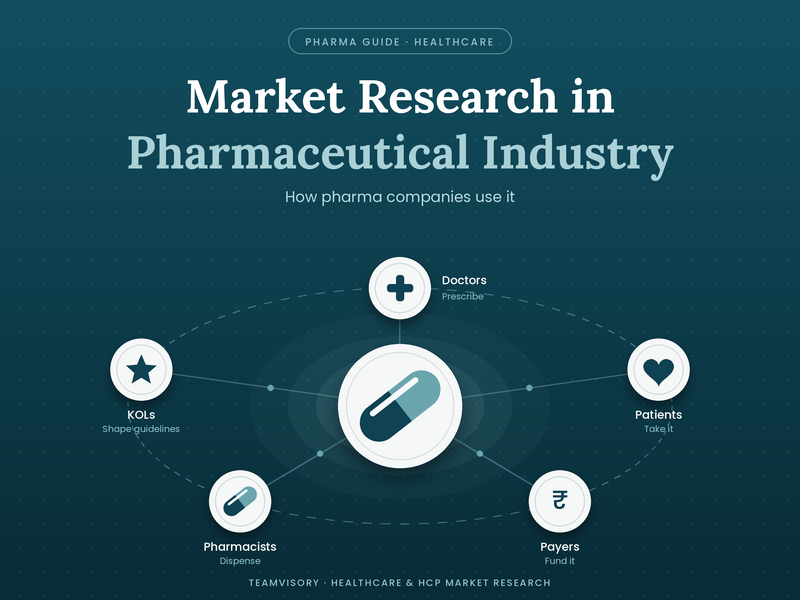
A pharma market research company works mostly with drug, biotech and device clients. They already know the therapy areas, the terms and the compliance steps, so you spend less time explaining basics. See our pharma and healthcare market research services.
A general firm can run a patient survey with the public without trouble. But if you need specialists or hospital decision-makers, ask what healthcare studies they have done. To see how drug and device teams use research across a product’s life, read how pharma market research companies use market research.
Types of healthcare market research agencies in India
| Type | Good for | Watch out for |
|---|---|---|
| Global healthcare specialist | Large pharma programmes across many countries | Higher cost, slower setup |
| India-based research and fieldwork firm | Local reach, regional languages, lower cost | Check for real healthcare experience |
| Panel-only provider | Quick access to respondents if you design and analyse yourself | You carry the risk on the questions and the analysis |
Running a study in Delhi NCR or Gurugram? Ask if the firm has its own team on the ground or hires fresh people for each project. Local teams sort out scheduling and language problems much faster. Our note on choosing a Market research Companyin Delhi goes deeper, and our guide to fieldwork in India shows how the work is usually split.
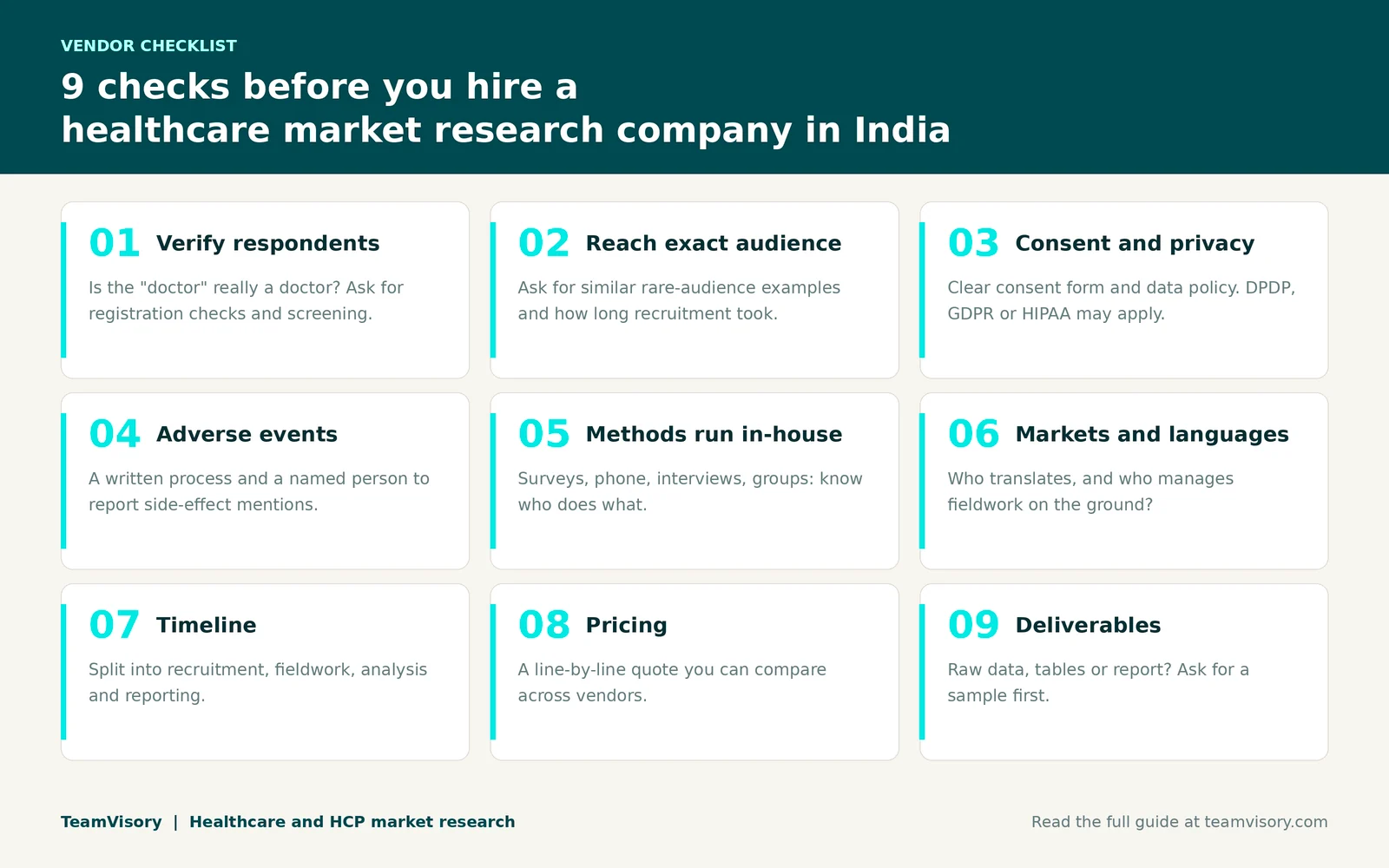
9 checks before you hire a healthcare market research company
1. How do they verify respondents?
You want to know that a “doctor” in the survey is really a doctor.
- Good answer: registration checks, a validated panel, and screening questions that catch fake answers.
- Bad answer: Our panel is high quality.
Also ask if they run their own online research panels or buy sample from someone else. How consumer panels are built in India shows what proper checks look like.
For example, in a study with 450 independent financial advisors across eight markets, we screened every respondent in more than one step, verified their professional credentials, blocked duplicates and ran consistency checks while the study was in field. Financial advisors are not doctors, but we use the same method for any specialist audience. For healthcare projects, we add specialty, practice setting and seniority to the screener.
2. Can they reach your exact audience?
Rare groups take time. Think oncologists in one city, or patients with a rare condition.
- Good answer: examples of similar audiences, and how long recruitment took.
- Bad answer: No problem, we can get anyone.
We have access to more than 2.3 million panelists across all audience types in six regions, and direct or partner panel access in 30+ countries. Healthcare professionals are a smaller part of that, and rare specialists depend on incidence. So we assess feasibility before we send a quote.
3. How do they handle consent and privacy?
Ask what respondents agree to, where their data is kept and who can see it. Depending on your study, India’s DPDP Act, 2023 and the DPDP Rules, 2025, GDPR or HIPAA may apply. Some provisions come into force in phases, so check the current requirements with your legal team before fieldwork begins.
- Good answer: a clear consent form and a written data policy.
- Bad answer: We follow all rules.
4. What do they do about adverse events?
If a respondent mentions a side effect of a pharma product during an interview, the vendor has to report it to you. Look for vendors that follow industry codes such as those of EphMRA and ESOMAR.
- Good answer: a written process, and a named person who handles it.
- Bad answer: a blank look.
5. Which methods do they run themselves?
Check whether surveys, phone interviews, one-to-one interviews and focus groups are done in-house or through partners. Partners are fine. You just need to know who does what.
6. Which markets and languages do they cover?
India has many languages, and it shows in the data. For studies across countries, ask who translates and who manages the fieldwork on the ground.
7. How long will it take?
Ask for a timeline split into recruitment, fieldwork, analysis and reporting. Rare audiences take longer. If someone promises everything in a week, ask how.
8. How is the price built?
Healthcare studies usually cost more than consumer studies, because specialist respondents are harder to find. Price mostly depends on sample size, how rare the audience is, the method, the number of markets and the length of the survey. Ask for a line-by-line quote so you can compare vendors fairly.
Planning an HCP study and need a quote you can compare? Tell us your audience and goal and we’ll send a clear, itemised breakdown.
9. What will you actually get?
Raw data, tables, a short summary, a full report or a presentation? Ask for a sample. Check that the analysis answers business questions and doesn’t just list numbers.
Red flags in a proposal
- No clear answer on how respondents are verified
- A guaranteed sample for a very rare audience, with no explanation
- One flat price and no breakdown
- Nothing about consent, privacy or adverse events
- Case studies that don’t say who the audience was or how the study ran
Five questions for your first call
- Who exactly will you speak to, and how will you find them?
- How many similar studies have you run in the last two years?
- What incidence rate are you assuming, and what happens if it comes in lower?
- Who is on my team, and who does the analysis?
- What is not included in this quote?
Ready to plan your study?
TeamVisory recruits healthcare, patient, caregiver and specialist audiences across 30+ countries through direct and partner panels. We run online surveys, phone interviews, in-depth interviews and focus groups. Tell us who you want to reach and what you need to decide. We’ll suggest an approach and send a clear quote.
Talk to our healthcare research team.
Frequently asked questions
It is a firm that collects and studies data from patients, doctors and other healthcare stakeholders, so companies can make better decisions on products, pricing, positioning and launches.
An agency usually designs the study and analyses the results. A fieldwork firm recruits respondents and collects the data. Some offer both.
Check how they verify respondents, what they have done in your therapy area, how they handle compliance, how long they need, and how the quote is built. Ask for examples of similar studies.
It depends on the specialty, the sample size, the method and the number of markets. Specialists like oncologists cost more than general physicians or patient samples. Ask for an itemised quote.
A simple online survey can finish in a few weeks. Rare audiences, interviews and multi-market studies take longer. Ask for a timeline for each stage.
If your study involves doctors, specialists or sensitive health topics, yes, or at least a team with proven work with that audience.
 Market Research for Starting a Business: What to Do Before You Invest
 Market Research in Pharmaceutical Industry: How Pharma Companies Use It
 International Market Research Fieldwork: A Complete Guide for Multi-Country Studies