
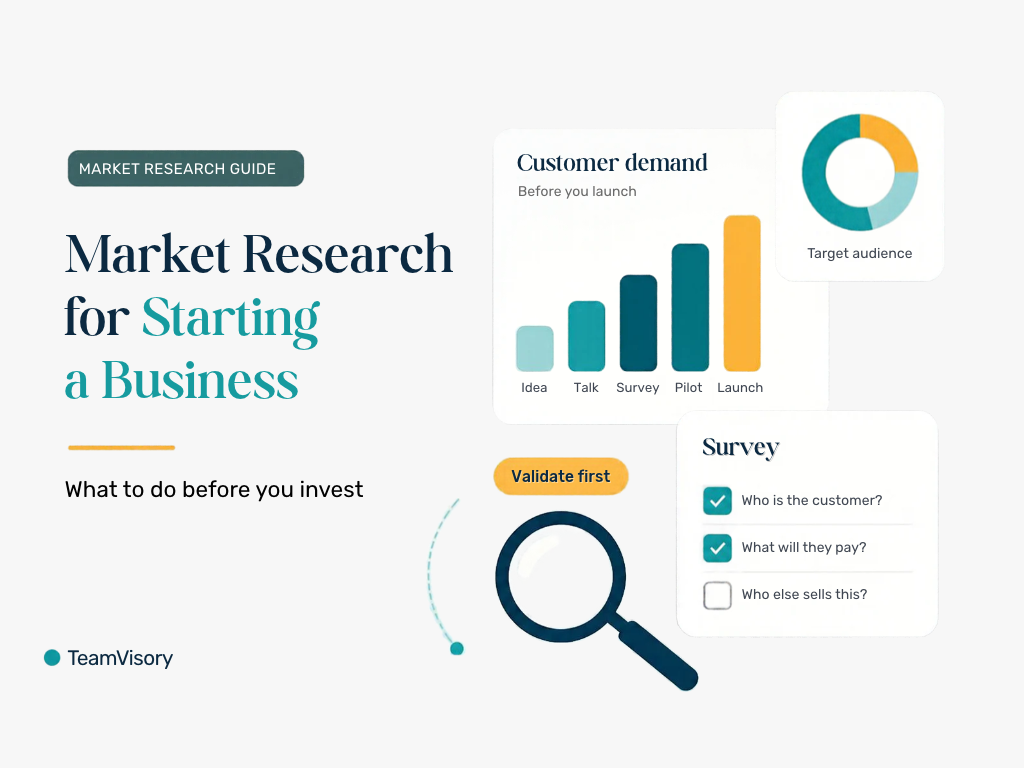
Market research for starting a business means finding out, before the money goes in, whether anyone wants what you're planning to sell. And if they do, who they are and what they'll pay.
A lot of founders skip this. They've got the idea, they're excited, so they build. Then the first customers don't show up the way they imagined. Doing the research first takes a few weeks. Doing it after takes a lot more than that.
Here's how to go about it: what to look into, how to run a market research survey that's worth the effort, and when it makes sense to bring in customer research companies or a market research agency.
What is market research for starting a business?
Simply put, it's studying your likely customers and your market before you launch. There are two sides to it. One is reading what's already out there: industry reports, government data, competitor websites, customer reviews. Researchers call this secondary research. It's quick, cheap, and good for market size and knowing who your competitors are, though it may not fit your city or your exact customer.
The other is asking people yourself, through conversations or a survey. That's primary research. It takes longer and costs more, but it's where you find out what your customers actually want and what they'd pay. It's only as good as your questions and the people you ask.
What should you find out before you launch?
Is there demand? That's the first thing. Do enough people have this problem, and are they already spending money on it? Then who the buyer is, and what they're using right now. Then the competition, and what their customers complain about. The complaints are usually where your opening is. After that, price: what people pay today, and what it would take to make them switch. Last, whether you can reach these people at a cost that makes sense.
Leave any of those blank and you've found where to start.
How do you do market research for a new business?
Begin with the decision. Write it down: "Should I open here?" or "Can I charge this much?" Without one, you'll collect facts and never use them.
Then read. Reports, public data, competitor sites, reviews. It's slow, but it's free, and you'll learn how big the market is and who's in it. Next, talk to people who might buy. Keep it loose and let them ramble. There's no magic number of chats. Once you stop hearing anything new, stop. Run a survey after that, when you know what to ask, to see how widely those views are held.
Check competitors the way a customer would: prices, offers, reviews, how easy it is to buy. If you can, test a small version before the big launch. A pre-order page is enough. What people do beats what they say. And decide your stop rule before the results land. What would make you go ahead, change plan or quit? Write it down. Otherwise good news is easy to find in mixed data.
Also Read: How To Conduct Market Research for new product launch?
How do you run a market research survey that gives usable answers?
A market research survey is a fixed set of questions sent to a defined group, to measure how common a need, habit or opinion is. When one turns out useless, it's rarely the numbers. It's the questions, or the people who answered.
Ask what people do, not what they'd do
Would you buy this? gets a polite yes almost every time. "Ask" When did you last buy something like this, and what did you pay? and you'll get something you can actually use.
Ask what people do, not what they'd do
Would you buy this? gets a polite yes almost every time. "Ask" When did you last buy something like this, and what did you pay? and you'll get something you can actually use.
Reach the right people
Five hundred answers from the wrong people are worth less than fifty from the right ones. Decide who your customer is first, then add a screening question or two at the start so only people who fit can carry on.
Pick a method that fits your audience
• Online surveys are quick and cheap. They work well if your customers are easy to find online.
• Phone interviews (CATI) are better for people who won't fill in an online form, like older customers or busy business owners.
• Face-to-face or in-depth interviews are the choice when you need the "why", or when the topic is awkward to squeeze into a form.
Keep it short
One idea per question. No leading wording like How much do you love our idea? Cut anything you won't act on. People quit long surveys, and the ones who stay start clicking anything.
Customer research companies, online market research companies and a market research agency: what's the difference?
The names overlap, and every firm describes itself a bit differently. But roughly:
• Online market research companies mostly run surveys through online panels or platforms. They're fast and affordable for broad consumer audiences, though you usually write the questionnaire yourself.
• Customer research companies concentrate on why people buy and what they need. Expect interviews and group discussions alongside surveys.
• A market research agency usually runs the whole job: planning, fieldwork, analysis, and a recommendation at the end.
Ask each one what's actually in the quote. That's where they differ most.
When should a new business hire a market research agency?
If your budget is small and your customers are easy to reach, do it yourself. Hire a market research agency when:
• big amount of money depends on the answer, like a factory, a franchise or a launch in several cities
• you need people you can't reach on your own, such as respondents in other cities or countries, or specialist professionals
• you want a neutral read, because founders tend to hear what they hope to hear
• investors or a lender will want to see how the numbers were produced
There's a cost, of course. An agency is pricier than a DIY survey, and it needs a clear brief. Give it a vague one and you'll get vague findings back.
Questions to ask before you hire
- How do you find respondents, and how do you check their quality?
- Who will actually run my project day to day?
- Do I get the raw data, or only the report?
- How will you decide the sample size for my question?
- What's included in the price, and what costs extra?
A simple example (illustrative, not a real client)
Say someone wants to start a cold-pressed juice delivery service in one city. She begins by reading about what households spend on packaged drinks. Then she talks to a handful of office workers and notices they care more about convenience than the health angle she planned to lead with. A short survey of working professionals backs that up, and it also shows a price ceiling lower than she'd assumed.
So she changes the plan: smaller bottles, office delivery first, a lower starting price. She learns this before signing a lease or buying equipment. That's what good research does. It rarely gives you a plain yes or no. It tells you what to change.
Start with the research, not the launch
You don't need a big budget for market research for starting a business. You need a clear question, the right people, and the willingness to accept answers you didn't want. Start with free reading, talk to real customers, and run your market research survey properly. If the stakes, the audience or the method are bigger than you can handle yourself, that's when to bring in a market research agency.
If you're weighing up your options, TeamVisory can help you work out the right approach for your idea. Have a look at our market research services, or get in touch and tell us what you're trying to find out.
Frequently Asked Questions
It tells you whether people actually want what you're planning to sell, before you've put money into it. You also learn who your customers are, what they pay now, and how competitors operate. It can't guarantee success, but it often shows you what to change early, while changing is still cheap.
A market research survey is a set of questions you send to a specific group of people to see how common a need, habit or opinion is. For a new business, it answers things like how often people buy, what they pay now, and which features matter. It only works if the right people answer.
You can do a lot yourself: read public reports, study competitors, talk to a few customers. An agency makes sense when a lot of money is at stake, your audience is hard to reach, or you need an independent method you can defend. Plenty of founders start alone and bring in help for the final check.
They study who your buyers are, what they need, and how they decide. Most use interviews, group discussions and surveys. You end up with a clearer picture of customer behaviour to guide your product, pricing and messaging. What's included varies from firm to firm, so check the scope before you sign.
These companies collect data through online surveys and respondent panels. They suit studies where speed and cost matter and your audience is active online. They're a weaker fit for people who are hard to reach digitally, like some older consumers, where phone or in-person interviews work better.
Ask how they recruit respondents and check quality, who runs your project, what you'll receive at the end, and whether you get the raw data. Ask how they'd set the sample size for your question. Then compare what each quote includes, not just the price, because the scope can differ a lot.
 Market Research in the Pharmaceutical Industry: How Pharma Companies Use It
 International Market Research Fieldwork: A Complete Guide for Multi-Country Studies
 Market Research Company in India: A Global Agency's Guide to Fieldwork