
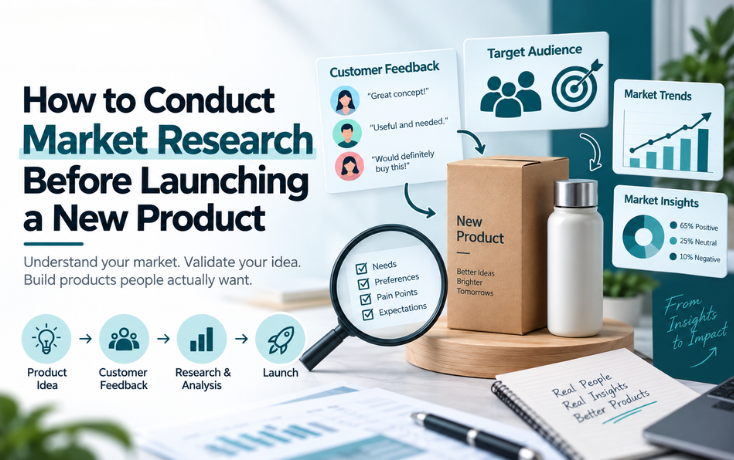
You can spend months building a product, refining the design and preparing a launch campaign and still discover that customers don't want it as much as you expected. The problem isn't always the product itself. Sometimes the audience is wrong. Sometimes the price doesn't feel right. Sometimes customers already have a better alternative. And sometimes the product solves a problem that isn't important enough for people to pay for.
This is why market research for a new product launch should happen before the major investment is made. Research gives you an opportunity to hear from potential customers, understand the market, study competitors and test your idea before you put the full launch behind it. It doesn't guarantee success, but it can make your decisions a lot less dependent on guesswork.
Why Do Market Research Before Launching a New Product?
Think about the decisions you have to make before a launch. Who should you sell to? Which features should you prioritise? What should the product cost? How should you position it? Is your idea actually different from what's already available? You may have answers to these questions internally, but your customers may see things differently.
For example, your team might believe that a new feature is the biggest reason someone will buy your product. Research could show that customers actually care more about ease of use or price. That kind of feedback is much easier to act on before launch than after you've spent heavily on production and marketing.
Good product research can help you:
- Understand customer needs and pain points
- Identify the right target audience
- Find gaps in the market
- Compare existing competitors
- Test product concepts
- Improve product features
- Understand price expectations
- Measure purchase interest
- Refine your positioning and messaging
The point isn't to collect as much data as possible. The point is to find information that helps you make a better decision.
What Should You Research Before Launching a New Product?
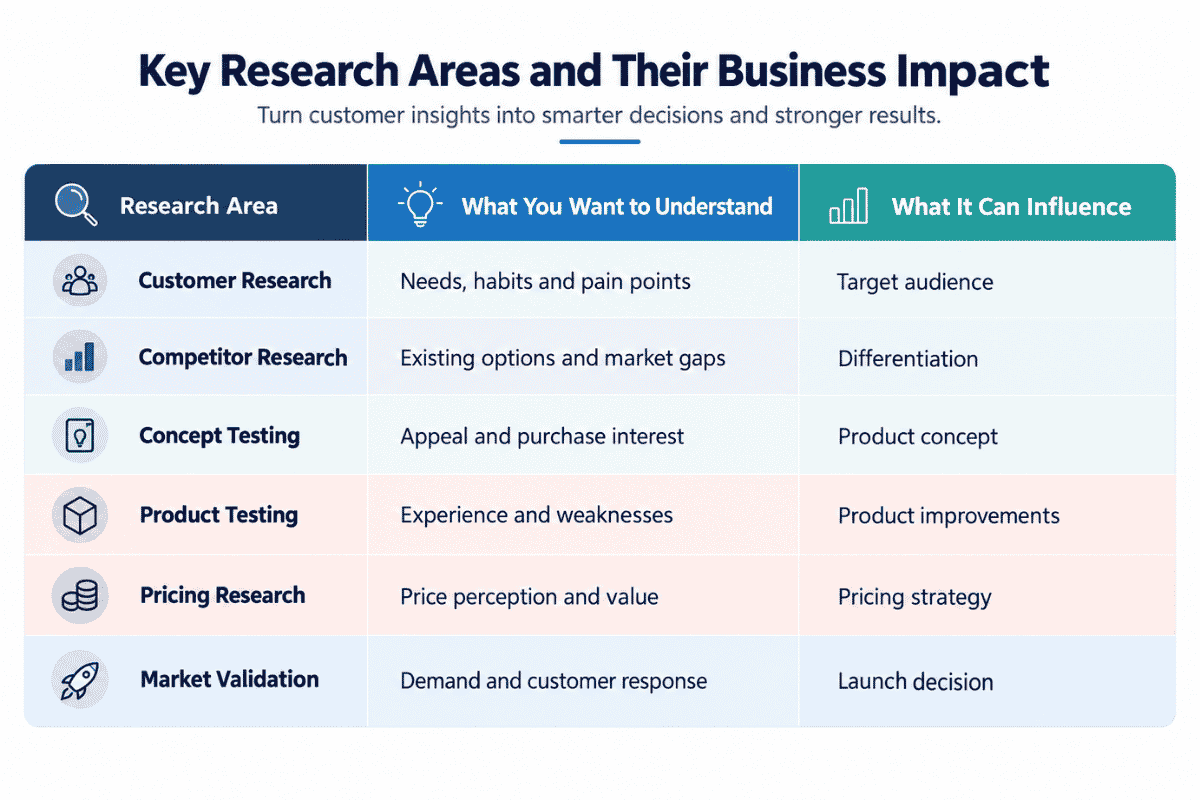
A useful new product market research study starts with the questions that matter to your business. Depending on the product and stage of development, there are several areas worth exploring.
1. Understand Your Target Customers
Start with the people who might actually buy your product. Go beyond basic demographics. Try to understand what problem they're trying to solve, how they currently solve it and what would make them consider changing.
You might want to explore:
- Buying habits
- Customer needs
- Pain points
- Product preferences
- Usage behaviour
- Purchase motivations
- Barriers to purchase
- Willingness to pay
For B2B products, the research may also need to consider industry, company size, job role, decision-making authority and business challenges. The better you understand your audience, the easier it becomes to build a product around a real need rather than an assumption.
2. Study the Competition
Your customers already have choices. Look at competing products and ask what they do well, and where they fall short.
Compare things such as:
- Features
- Pricing
- Product quality
- Positioning
- Customer experience
- Distribution
- Reviews and complaints
You aren't looking for something to copy. You're looking for an opportunity. A recurring complaint in customer reviews, for instance, may point towards a genuine market gap. That gap could become part of your product strategy.
3. Test the Product Concept
You don't need a finished product to start learning from customers.Concept testing allows you to show potential customers an early product idea and understand how they react to it. You can test the concept's appeal, relevance, uniqueness, perceived value and likelihood of purchase.
This becomes particularly useful when you have two or three ideas and aren't sure which one deserves further investment.
“Which one do you like?” you can structure the research around more useful questions:
- Would you consider buying it?
- What problem does it solve for you?
- What do you like about it?
- What concerns you?
- What would make you choose another option?
The answers can reveal much more than a simple thumbs-up or thumbs-down.
4. Test the Product Before the Full Launch
Concept testing tells you how people respond to the idea. Product testing lets you learn from their experience with the actual product or prototype.
Depending on the category, participants may evaluate:
- Ease of use
- Product performance
- Design
- Packaging
- Features
- Quality
- Overall experience
This stage is particularly useful when the product is already developed but there is still time to make improvements.A small usability issue that seems insignificant to an internal team can become a real barrier for customers. Testing gives you a chance to discover those issues while they're still fixable.
5. Find a Price Customers Are Comfortable With
Pricing is one of the easiest areas to get wrong. Your production costs tell you what you need to charge. They don't necessarily tell you what customers think the product is worth. Pricing research can help you understand how customers respond to different price points and whether the perceived value supports your intended positioning.
For example, research might reveal that customers are interested in your product but see little reason to pay a premium over an established competitor. That doesn't automatically mean you need to reduce the price. You might instead need to strengthen the product, change the positioning or communicate its benefits more clearly.
Which Market Research Method Should You Use?
There isn't one research method that works for every product. The right choice depends on what you need to find out.
Qualitative Research
If you want to understand why customers think or behave in a certain way, qualitative research can be useful. Interviews and focus groups can help uncover motivations, frustrations, expectations and reactions that aren't always easy to capture through a structured survey.
For example, a customer might say they don't like a product. A conversation can uncover that the real problem isn't the product itself, it is that the product feels complicated to use. TeamVisory's Qualitative Research services can support businesses looking for deeper customer understanding.
Quantitative Research
If you need measurable feedback from a larger audience, quantitative research can help. Surveys can be used to measure purchase intent, feature preferences, customer satisfaction, price perceptions and differences between audience segments.
TeamVisory's Quantitative Research services can be used when businesses need structured, measurable market insights. In many cases, combining both approaches makes sense: qualitative research helps explain why, while quantitative research helps show how widespread a particular finding is.
How to Conduct Market Research Before Launch
Once you know what you need to learn, the process becomes much clearer.
Step 1: Start With a Business Question
Don't begin by choosing a survey template. Start by asking:
What decision do we need this research to help us make? It could be whether to launch a product, choose between concepts, change a feature, identify a target segment or set a price.
Step 2: Define the Right Audience
Decide exactly who should participate. Your audience criteria might include location, age, income, product usage, buying behaviour or other relevant characteristics. For B2B research, you may need respondents from particular industries, company sizes or professional roles.
Step 3: Choose the Research Method
Now choose the method that fits your question. You might use:
- Online surveys
- In-depth interviews
- Focus groups
- Concept testing
- Product testing
- Online panel research
- Pricing research
Sometimes one method is enough. Sometimes a combination gives you a clearer picture.
Step 4: Collect Quality Responses
A large sample isn't automatically a good sample. The people taking part need to match the audience you're trying to understand. Screening criteria and respondent-quality checks are particularly important when researching specialised or hard-to-reach groups.
Step 5: Look for Patterns
Don't get distracted by individual comments. Look for recurring themes, differences between customer groups, purchase drivers and reasons people hesitate.
The useful question is: “What does this finding mean for the product or launch?”
Step 6: Make a Decision
This is the part that often gets overlooked.Research should lead somewhere.
You might decide to:
- Improve a product feature
- Change the target audience
- Adjust the price
- Refine the positioning
- Test another concept
- Change the launch message
- Move ahead with greater confidence
The goal isn't to produce a report full of charts. The goal is to make the next business decision with better evidence.
When Should You Conduct Product Market Research?
Research shouldn't necessarily be left until the week before launch it can be useful throughout product development.
- Idea stage: Is there a genuine customer problem?
- Concept stage: Does the idea appeal to the intended audience?
3.Development stage: What needs to change? - Pre-launch: Are the product, price and positioning ready?
- Post-launch: What are customers saying about the experience?
Research can therefore become an ongoing feedback loop rather than a one-time exercise.
Customer Research Into a Smarter Product Launch
A product launch doesn't have to be a leap of faith. The more you understand your customers before launch, the easier it becomes to make decisions about the product, audience, pricing and positioning.
Market research before launching a product can help you test assumptions, uncover customer needs, identify market opportunities and find problems while there is still time to fix them.
At TeamVisory, research programs can be built around the specific audience and business question you're trying to answer. From qualitative and quantitative research to online panel studies, consumer research and product testing, the focus is on turning customer feedback into useful business insight.
Talk to TeamVisory about your product research requirements.
Have a product idea you're preparing to launch? Start by finding out what your potential customers actually think.
 Market Research in the Pharmaceutical Industry: How Pharma Companies Use It
  International Market Research Fieldwork: A Complete Guide for Multi-Country Studies
  Market Research Company in India: A Global Agency's Guide to Fieldwork