
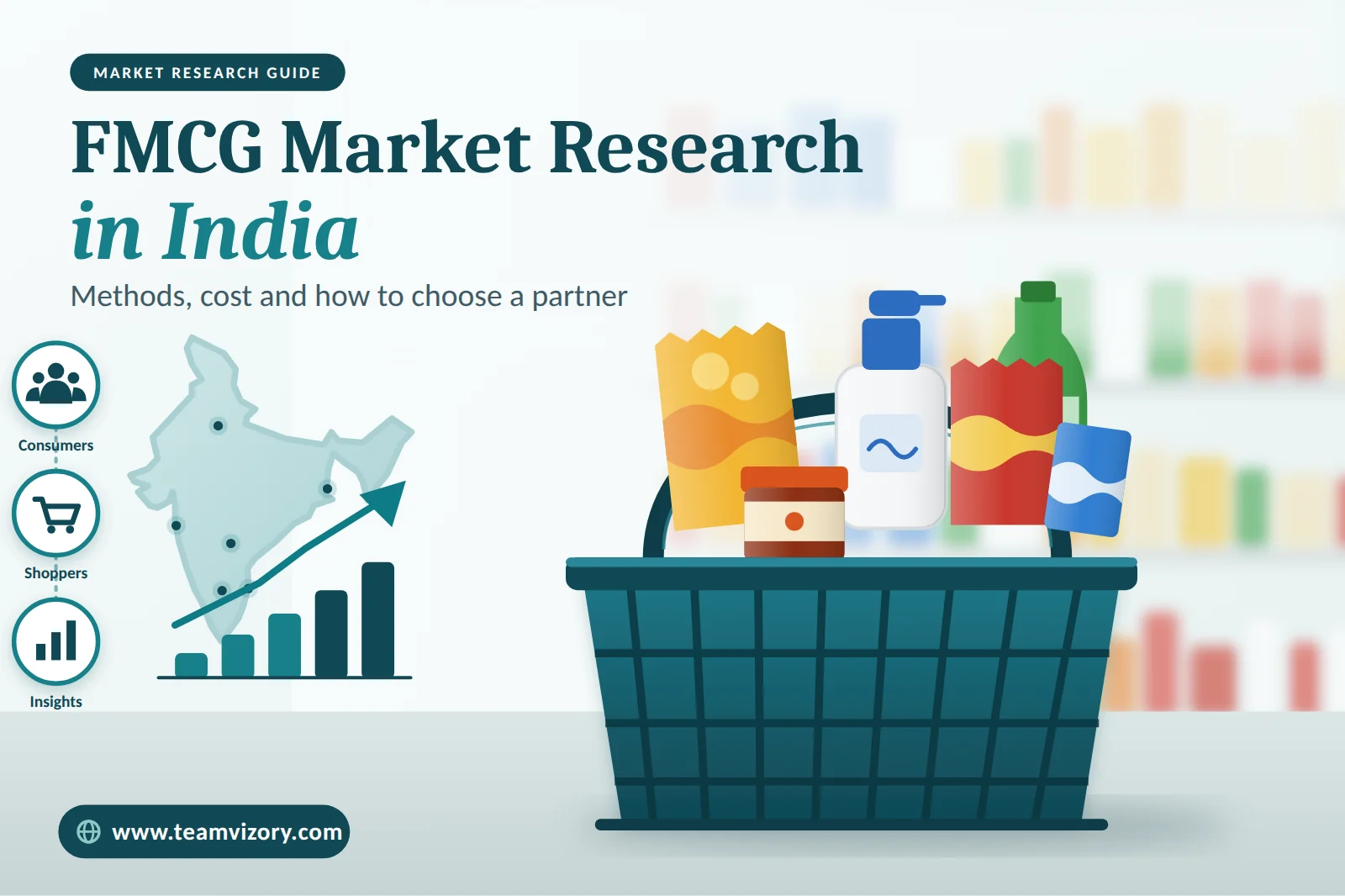
FMCG market research in India is not the same as running a study in Mumbai and applying it to Patna. Languages change. Shelf space changes. A small sachet can win in one town while a big family pack wins in the next. If you sell fast-moving consumer goods here, your research has to reflect how India actually shops.
This guide explains what FMCG market research is, why brands need it, which methods work, what to look for in consumer insights, and how to choose the right research partner.
Quick answer: FMCG market research is the process of collecting and studying data about consumers, products, prices, stores and competitors in categories like food, drinks, personal care and home care. Brands use it to decide what to launch, how to price it, where to sell it and how to fix what is not selling.
In this guide: what FMCG market research is, why brands need it, types of services, methods, consumer insights, common mistakes to avoid, how to choose a research company, cost, and FAQs.
Planning an FMCG study right now? Share your brief with TeamVisory and we will reply with a suggested approach.
What is FMCG market research?
FMCG market research is the study of how people buy and use fast-moving consumer goods, which are everyday products that are bought often and sold quickly. Think biscuits, tea, soap, shampoo, detergent, packaged snacks and soft drinks.
It answers practical questions such as:
• Who buys this product, and why?
• Which pack size and price feel right?
• Why do shoppers pick a competitor at the shelf?
• Will a new product get a second purchase, not just a first trial?
• Which cities, towns or channels should we focus on?
Good research does not stop at numbers. It explains the reason behind the numbers, so your team can take a decision.
Why do FMCG brands need market research?
FMCG brands need market research because margins per unit are small and shelf space is limited. A wrong price, pack or claim gets expensive quickly, and you often find out only after stock is already in stores.
India makes this harder, for five reasons.
- The market is big and growing, so the stakes are high. IBEF estimates the Indian FMCG market at about US$289 billion in FY25 and projects around US$643 billion by FY30 (IBEF FMCG infographic, May 2026). More growth also means more competitors.
- Urban and rural shoppers behave differently. IBEF puts the FY26 revenue split at roughly 61% urban and 39% rural. A product tested only with metro consumers can miss a large part of the market.
- One country, many consumers. Taste, language, income and festivals change from state to state. What works in Kerala may not work in Punjab.
- Channels are mixed. Kirana stores, modern trade, e-commerce and quick commerce all matter now. IBEF notes that quick commerce has reached only about 7% of its potential market, so shopping habits are still shifting.
- Launches are risky. Testing a concept, pack or price before launch is cheaper than fixing a failed launch.
Types of FMCG market research services
When brands look for FMCG market research services, they usually need one of these:
| Type of study | What it tells you | Common method |
|---|---|---|
| Concept and product testing | Whether people like it, and whether they would buy it | Online or phone surveys, product trials |
| Pricing and pack research | Which price and pack size shoppers accept | Surveys with price testing |
| Usage and attitude study | How people use the category and what they care about | Surveys, interviews |
| Brand tracking | Awareness, consideration and preference over time | Repeat surveys |
| Shopper research | How people choose at the shelf or on an app | Store interviews, observation |
| Qualitative research | The "why" behind behaviour | Focus groups, in-depth interviews |
| Consumer panels | Repeat purchase and behaviour change over time | Panel surveys |
Most real projects mix two or three of these.
FMCG market research in India: which methods work?
There is no single best method. The right one depends on who you need to reach and what you need to know.
- CATI (phone surveys). Quick and good for reaching people across many cities. Works well for awareness, usage and satisfaction studies.
- CAWI (online surveys). Fast and cost-effective for larger samples. The limit is reach, since online samples lean towards internet-active, urban respondents. Do not use online alone if rural or small-town consumers matter to you.
- Face-to-face interviews. Needed when you must reach people with low internet use, show a physical pack, or run a taste test.
- Qualitative research. Focus groups and in-depth interviews help when you do not yet know the right questions. They work well before a launch or when sales fall for unclear reasons.
- Consumer panels. A fixed group of consumers tracked over time. Useful for repeat purchase and brand switching. See our guide on consumer panels in India or our online panel research service.
If you want to understand the difference between survey-led and discussion-led research first, read qualitative vs quantitative research and our quantitative market research guide.
FMCG market research process: 6 steps
A good FMCG study follows a simple path.
- Define the decision. Write down what you will do differently after the study. Launch or hold. Price up or down. Keep it to one sentence.
- Pick the audience. Who buys, who uses, and in which cities, towns and income groups.
- Choose the method. Phone, online, face-to-face, qualitative or a mix, based on who you need to reach.
- Design the questionnaire and sample. Keep questions short and in the respondent's language. Set the sample so each group you care about has enough responses.
- Run fieldwork with quality checks. Validate responses, back-check interviews and remove poor data.
- Turn data into a decision. Look for the finding that changes your plan, not a long deck of charts.
FMCG consumer insights in India: what to look for
Good FMCG consumer insights in India go beyond "who bought what." These are the areas that usually change a decision:
• Price per use, not just pack price. Many shoppers think in terms of what they can afford today. That is why pack size and price points matter so much.
• Regional taste and language. The same product, flavour or message can land very differently across states.
• Where people actually buy. The same shopper may buy staples from a kirana, bulk packs from modern trade and top-ups from a quick commerce app.
• The urban and rural gap. With about 39% of FMCG revenue coming from rural India (IBEF, FY26), rural behaviour cannot be a footnote.
• Health and premium shifts. IBEF reports that India's healthy snack market was valued at about Rs 27,065 crore in 2025 and is expected to reach about Rs 45,634 crore by 2034. Shoppers are paying more attention to what is inside the pack.
• Trust and switching. Why people stay with a brand, and what makes them try another one.
A simple example (illustrative): Say a biscuit brand sees repeat purchase fall in smaller towns. A survey shows the drop. Follow-up interviews may reveal that the new pack looks smaller for the same price. Now the team has a clear fix: pack size or price, not advertising.
FMCG market research by category
| Category | Questions brands usually ask | Often used methods |
|---|---|---|
| Food and beverages | Do people like the taste? Which pack size sells? Will they buy again? | Product trials, surveys, panels |
| Personal care | Do shoppers believe the claim? Why do they switch brands? | Surveys, focus groups |
| Home care | Is it worth the price per wash or use? What do shoppers trust? | Surveys, in-home or store interviews |
| Packaged snacks | Which flavour and price point win in smaller towns? | Surveys, taste tests, shopper research |
Common mistakes in FMCG market research, and how to avoid them
These mistakes come up often in FMCG studies. Avoiding them saves time and money.
• Researching only metro consumers. If your product will sell in smaller towns or rural areas, include those respondents.
• Testing the concept but not the price. A product people like can still fail at the wrong price or pack size. Test them together.
• Asking too many questions. Long surveys tire people and lower data quality. Keep every question tied to the decision.
• Ignoring how people buy. The channel changes what they buy. Ask where they shop, not only what they buy.
• Treating one study as the full answer. Use qualitative research to find the "why", then a survey to measure how big it is.
How to choose an FMCG research company in India
There are many FMCG research companies in India, from large global names to specialist field agencies. Use this checklist when you compare them:
- Category experience. Have they worked on food, beverages, personal care or home care? Ask what kinds of questions they have answered before.
- Field reach. Can they reach the cities, towns and languages you need?
- Methods under one roof. Phone, online, face-to-face and qualitative work. Fewer handoffs mean fewer errors.
- Data quality checks. Ask how they validate responses, back-check interviews and clean data.
- Sample design. They should explain why a sample size is right for your goal, not just quote a number.
- Standards. Ask whether they follow ESOMAR guidelines and can answer ESOMAR's 37 Questions for buyers of online samples. Also ask how they handle respondent consent and data privacy.
- Reporting. Do you get raw data, tables and a clear story with recommendations?
- Transparent pricing. A clear quote that lists what is and is not included.
ESOMAR's 37 Questions are written for buyers of online samples, so they matter most when your study includes online fieldwork. To see what a clear answer looks like, read TeamVisory's answers to the ESOMAR 37 Questions.
If you plan to outsource field work, read our note on market research fieldwork outsourcing in India.
What affects the cost of FMCG market research?
Cost changes from project to project. The main drivers are sample size, number of cities, method (online costs less than face-to-face), questionnaire length, how hard the audience is to find, number of languages and the depth of reporting. A good agency will give you a range after understanding your goal, not before.
Not sure what your study would cost? Share your category, cities and timeline. Our team will suggest a scope and a price range.
To get an accurate quote, send us:
• Your product category and the decision you need to make
• Your target audience (age, income, city or town type)
• The cities or regions to cover
• Your preferred method, if you have one (phone, online, face-to-face, qualitative)
• An approximate sample size, if you know it
• Your timeline
Working with an FMCG market research agency in India
A good FMCG market research agency in India should act like an extension of your team. It should help you frame the question, choose the right method, run clean field work and tell you what to do next.
TeamVisory works mainly on FMCG research. We run phone, online and qualitative studies and use our research panels to reach the right respondents. You can see how we work on our consumer research, quantitative research and qualitative research pages, or read about us as a market research company in India.
Planning a launch, a price change or a move into a new region? Talk to the TeamVisory team. Tell us your category, your question and your timeline, and we will suggest the right approach.
Where to start
FMCG market research in India works best when it is tied to a real decision: launch or hold, price up or down, push this pack or that one. Pick the method that matches your audience, check the agency's field quality, and ask for recommendations, not just charts. New to research? Start with our guide on market research for starting a business.
Frequently Asked Questions
Consumer research studies the people who buy: their needs, habits and reasons. Market research is wider and also covers competitors, pricing, channels and market size. In FMCG, most projects use both.
It depends on your audience and goal. Phone and online surveys are fast and cover large samples. Face-to-face research is better for rural or low-internet audiences and for product trials. Qualitative research explains the "why." Many studies use a mix.
Only sometimes. Online samples lean towards urban, internet-active people. If your product sells in small towns or rural areas, add phone or face-to-face research so those consumers are included.
There is no single number. It depends on how many groups you want to read separately, such as city, age or income, and how precise the results need to be. A good agency will explain its sample design in plain words.
It depends on the method and the number of cities. A simple online study can be quick, while multi-city field work takes longer. Ask for a timeline with each stage listed.
There is no fixed price. Cost depends on sample size, number of cities, method, questionnaire length and reporting depth. Online studies usually cost less than face-to-face field work. Share your brief to get a clear quote.
Yes, if the project is scoped well. A smaller study, such as one city, one question or one concept test, can give useful answers without a large budget.
 Healthcare Market Research Companies in India: How to Choose One
 Market Research for Starting a Business: What to Do Before You Invest
 Market Research in Pharmaceutical Industry: How Pharma Companies Use It