

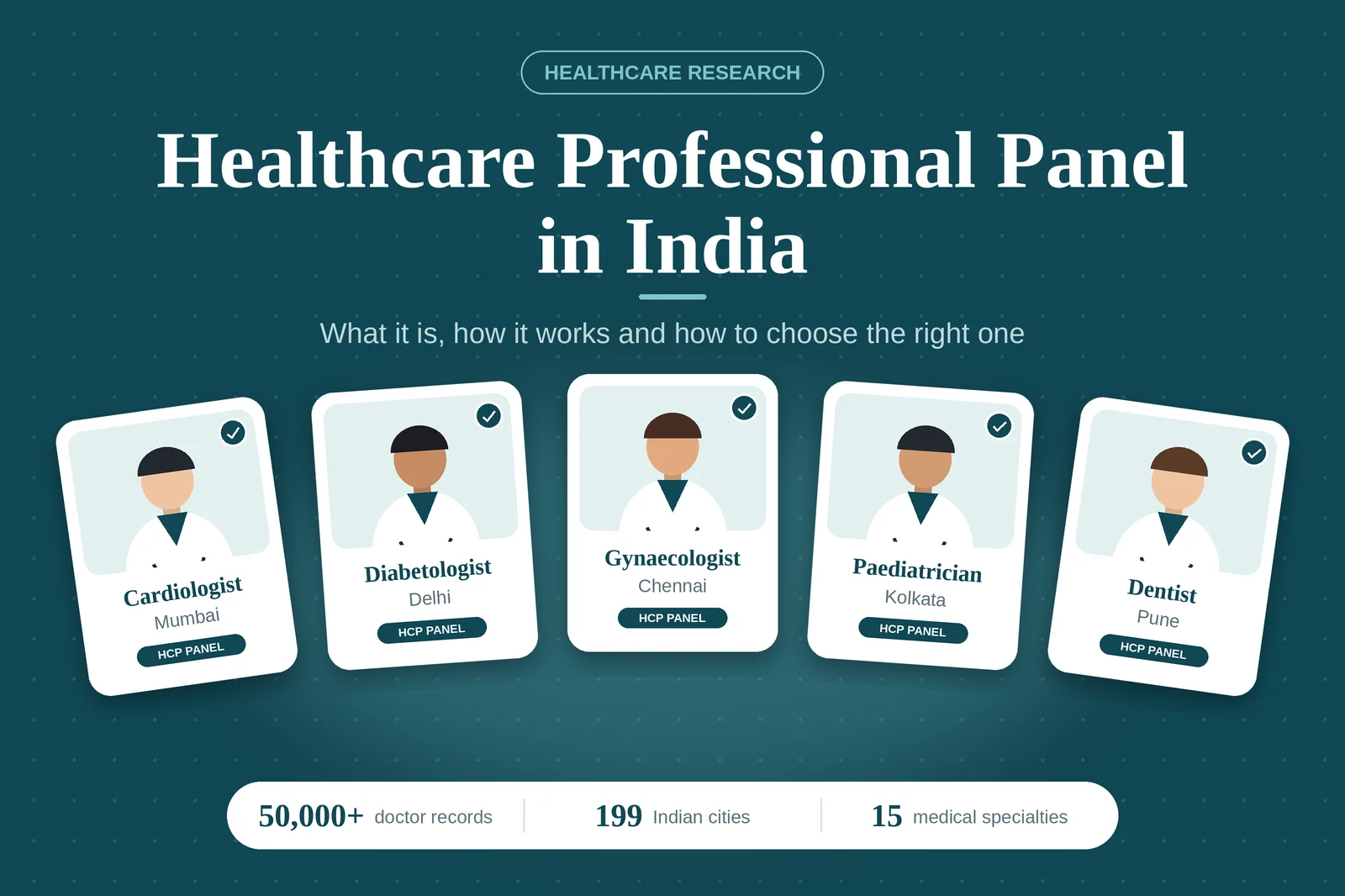
Quick answer: A healthcare professional panel in India is a group of doctors, nurses or pharmacists who can be invited to join research. Pharma, device and research teams use it to find the right specialists for surveys and interviews. A good panel is covered in your specialty, reaches your cities, and explains clearly how its records are checked.
Imagine you need 150 cardiologists across eight cities, and you need them in three weeks.
The doctors exist. Finding the right ones, fast, is the hard part. That is the job of a healthcare professional panel in India.
In this guide, we explain what a panel is and how it works. We also share eight questions to ask any provider before you hire them. That includes us.
What is a healthcare professional panel?
A healthcare professional panel is a pool of clinicians that a research team can invite to take part in a study. Each record usually has a specialty, a city and contact details. That lets the provider search the pool and count who fits your brief.
The panel is not the study. It is where the study starts. After it, you still need invitations, screening, fieldwork and quality checks.
What the panel gives you is speed and focus. You reach the right doctors sooner, and you know early whether your plan is realistic.
What does HCP mean?
HCP means healthcare professional. In market research, it mostly means practising doctors. It can also mean nurses, pharmacists, dentists and allied health staff.
You will also see HCP panel, physician panel, and doctor panel. They all point to the same idea: a pool of clinicians for research.
One quick warning if you are searching online. In India, panel physician usually means a doctor approved for visa medical exams. That is a different thing. Here, a panel is a pool of people who can join research.
Who is in a healthcare panel?
It depends on the provider. Most panels include some of these groups:
- General and consulting physicians
- Specialists, such as cardiologists, diabetologists, endocrinologists, gynaecologists and paediatricians
- Dentists
- Pharmacists and nurses, if the provider covers them
So always ask, "Which groups do you actually hold?" A panel that is strong for doctors may have little for nurses. TeamVisory's panel is built around doctor records. We say that upfront so you can decide if it fits your brief.
How a healthcare professional panel works
Most studies follow the same six steps:
- Share the brief. Say which specialties, which cities, which type of doctor, and how many completed responses you need.
- Check feasibility. The provider counts how many matching doctors are in the panel. This is where an unrealistic plan gets caught early.
- Invite. Matching doctors are contacted by phone or online.
- Screen. A few short questions confirm each doctor really fits. For example, how many patients they see with a certain condition.
- Run the study. This could be a phone survey (CATI), an online survey (CAWI) or an in-depth interview.
- Check and deliver. The data is cleaned and shared with you.
One thing surprises many first-time buyers. Being in a panel does not mean a doctor will say yes. Doctors are busy, so you always invite more people than you need. Our sample size guide for HCP surveys shows how to work out the numbers.
Planning a study right now? Send us your brief, even a rough one. We will tell you what looks realistic. Share your brief.
Who uses healthcare panels in India?
| Who | What they use it for |
|---|---|
| Pharma companies | Prescribing habits, brand views, unmet needs, product launches |
| Medical device makers | How a device is used, which features matter, why doctors hesitate |
| Research agencies | Finding respondents for their own client projects |
| Consultants | Quick expert views for strategy and market-entry work |
| Healthcare startups | Early checks with real practising doctors |
India adds a twist. Practice patterns differ between big metros and smaller cities. A study that stays in the top six cities can miss how most of the country practises.
In some specialties, the total number of doctors is small. So it helps to know early how many you can actually reach. For more on this, read our guide to choosing a healthcare market research company in India.
Panel, database or on-demand recruitment?
Healthcare panel providers in India use these words loosely. Here is a simple way to tell them apart.
| Option | What it is | Best for | Ask about |
|---|---|---|---|
| Research panel | A managed pool of clinicians who can be invited to studies | Repeat studies and fast feasibility checks | How the pool is built and refreshed |
| Doctor database | A list of doctor records with profile fields | Planning samples by specialty and city | Whether the records can be used for research outreach |
| On-demand recruitment | Doctors are found fresh for each project | Rare specialties and niche profiles | Time and cost per completed response |
Many providers mix all three. The label matters less than the answers to the questions below.
Eight questions to ask before you choose
These are the questions we would ask if we were the buyer. Ask them of every provider, including us.
| Question | Why it matters | A good answer sounds like |
|---|---|---|
| How many records do you have, by specialty? | A big total means little if your specialty is thin | Clear numbers by specialty, shared on request |
| Which cities do you reach? | Multi-city studies fail without depth outside the metros | A real city list, not just pan-India |
| How do you verify doctors? | Weak checks lead to weak data | A plain, step-by-step answer |
| How do you handle consent and data protection? | Contact data must be used with care | A direct answer that covers India's DPDP Act, 2023 |
| How fresh are the records? | Doctors move, retire and change numbers | A stated way of keeping records current |
| How do you catch duplicates and poor responses? | Repeat or rushed answers spoil results | A clear list of checks |
| Which methods can you run? | You may need phone, online and interviews | A yes or no for each method |
| Can I see feasibility before I commit? | You need numbers before you sign | A written estimate before the project starts |
A provider who answers all eight clearly is usually worth talking to.
Red flags to watch for
- A huge headline number with no split by specialty or city
- Vague answers on checking doctors and getting consent
- A promise of guaranteed completes, fast, for a rare specialty
- No written feasibility before the quote
- No willingness to explain how the panel was built
None of these proves a provider is bad. Each one is a signal to ask a follow-up.
What changes the cost and timeline?
There is no standard price, because every brief is different. These things move it the most:
- How rare the specialty is. Common specialties are faster to reach.
- Sample size. More completed responses means more work.
- Subgroups. Every extra split, such as city or specialty, needs its own group of doctors.
- Survey length. A 10-minute online survey is a different job from a 45-minute interview.
- Who qualifies. If few invited doctors pass the screening questions, you must invite more.
- Geography. Smaller cities can take more effort.
- Deadline. A tight deadline usually means a wider invitation list.
The best way to get a real number is a written scope and feasibility from your provider.
Where TeamVisory fits
TeamVisory's healthcare professional panel in India holds 50,000+ doctor records. They cover 199 Indian cities and 15 medical specialties.
Each record is organised by fields such as specialty, city, location, doctor type and contact details. That lets us plan a sample by specialty and city before fieldwork starts. Fields can vary from record to record.
We use the panel for:
- Phone and online surveys (CATI and CAWI)
- In-depth interviews for qualitative research
- Finding and screening doctors for a study
- Feasibility checks before a sample is fixed
Want a closer look at the panel itself? Fill inside Teamvisory's HealthCare Research panel. You can also see our healthcare market research services. If pharma is your field, market research in the pharma industry is a good next read.
When you talk to us, ask the eight questions above. We would rather answer them early than have you find the gaps later.
Not sure what your study needs?
Send us your brief, even a rough one. Tell us who you want to reach and where. We will help you work out what is realistic. Talk to our healthcare research team.
FAQs about healthcare professional panels in India
It is a pool of doctors, nurses, pharmacists or other clinicians that a research provider can invite to take part in surveys and interviews. Records are organised so respondents can be found by specialty, location and other details.
HCP stands for healthcare professional. In research, it most often means practising doctors. It can also include nurses, pharmacists and dentists.
A database is a list of records. A research panel is a pool managed for research. Providers use both terms loosely, so ask how the records were built and how they can be used.
The panel holds 50,000+ doctor records across 199 Indian cities and 15 medical specialties.
That depends on the provider. Ask for the city list and the depth by specialty. Teamvizory's panel covers 199 Indian cities, including metros and many smaller cities.
Share your brief through our contact page. Tell us the specialties, cities, method and sample size you have in mind. We will talk through feasibility and next steps.
 Why Healthcare Market Research Matters More Than Ever in 2026-27
 FMCG Market Research in India: A Practical Guide for Brands
 Healthcare Market Research Companies in India: How to Choose One