
If you're looking for a B2B market research company, you probably have a question that guessing won't settle. Why are we losing deals? Is this market big enough? Will buyers actually pay for this?
The right partner finds the right people, asks them the right way, and tells you what to do next. This guide explains what B2B research companies do, which services fit which question, what drives the price, and how to spot a weak partner before you sign anything.
The quick answer: Pick a partner for the people they can reach, not the logos on their website. Use surveys to learn "how many" and interviews to learn "why". If a company won't tell you where its respondents come from, walk away. And always ask for an itemised quote.
Short on time? Take a look at our B2B and B2C Panel Book to see how we reach business buyers. Or talk to our team about your question.
Who is this guide for?
It's for anyone about to hire a research partner and who wants to compare options properly. That might be a marketing head, a product manager, a founder or a strategy lead.
It is not a ranked list of companies. It's a checklist you can use on any provider, including us. If you'd rather see what we offer first, our B2B market research services page has the details.
What does a B2B market research company do?
A B2B market research company studies how business buyers think, choose and buy. It does this by talking to the people behind a business purchase. That could be a procurement head, an IT manager, a plant owner, a doctor or a CFO.
Then comes the behind-the-scenes work. Planning the study. Finding respondents. Running the fieldwork. Cleaning the data. Writing it all up.
That last step matters most. A folder full of charts isn't research. You need a clear answer and a next step.
Which B2B market research services do you need?
Start with the decision you have to make. The method comes after that.
| If this is your problem | Ask for this |
|---|---|
| You're losing deals and don't know why | Win-loss interviews with buyers who chose you and buyers who chose someone else |
| You need to size a market | A survey plus desk research. The result is only as good as its assumptions, so ask to see them |
| You don't know what to charge | Pricing and concept testing with the people who control the budget |
| You're not sure who your real buyer is | Interviews and a segmentation survey with users, influencers and approvers. They're often three different people |
| You want to know if customers are happy | A satisfaction survey, then interviews to understand the reasons behind the scores |
| You're new to an industry | Expert interviews. They're the fastest way to learn who the players are and what the risks look like |
Most B2B market research services come down to two things. Quantitative research gives you the numbers. Qualitative research gives you the reasons. Not sure which one you need? Our guide to qualitative vs quantitative research will help.
Some providers sell business market research services as fixed packages. Others build B2B market research solutions around your one question. Both can work if the method fits what you need to know.
Firm, agency or consultant: does the label matter?
Not really. People use these words loosely, and the lines blur.
A B2B market research firm usually runs the whole project, from the brief to the final report. A B2B market research agency is often smaller and faster, and may have a marketing angle. B2B market research consultants are strong on strategy and on making sense of results, but they sometimes hire someone else for the fieldwork.
So skip the label and ask four things:
- Who will you speak to?
- How do you find them?
- What will I get at the end?
- Who actually runs the fieldwork, you or a partner?
Research, market intelligence and market analysis
People mix these up all the time. Here's the short version.
Market research asks real people new questions. B2B market intelligence tracks competitors, pricing and news over time, using sources that already exist. B2B market analysis works through data, yours and public, to size a market and spot gaps.
Use analysis to decide where to look. Use research to find out why.
Why is B2B customer research harder than consumer research?
Because the people you need are few, senior and busy. A survey built for shoppers will fall flat with a procurement director.
Here's what makes B2B customer research tough:
- The group is small, so every wrong respondent hurts the data.
- Senior people get a lot of requests and answer very few.
- Job titles are hard to check from the outside.
- One purchase often involves users, influencers and approvers, and each sees it differently.
You may also see the phrase B2B consumer insights. It points to the same goal: understanding how buyers think and decide. The buyer is just a company instead of a shopper.
That's why recruiting is the heart of this work. Good providers mix B2B panels, phone interviews (CATI) and direct outreach. They screen every person for job role, company type and company size. Afterwards, they remove duplicates and rushed answers.
If your audience is shoppers rather than businesses, see our consumer research panel page instead.
What does a B2B research project look like?
Most projects follow the same six steps: a brief, an agreed method and sample, recruiting and screening, fieldwork, quality checks, then analysis and a report.
Here's a made-up example, not a real client. A software company sells to mid-sized manufacturers. It keeps losing deals at the final stage, and nobody can say why.
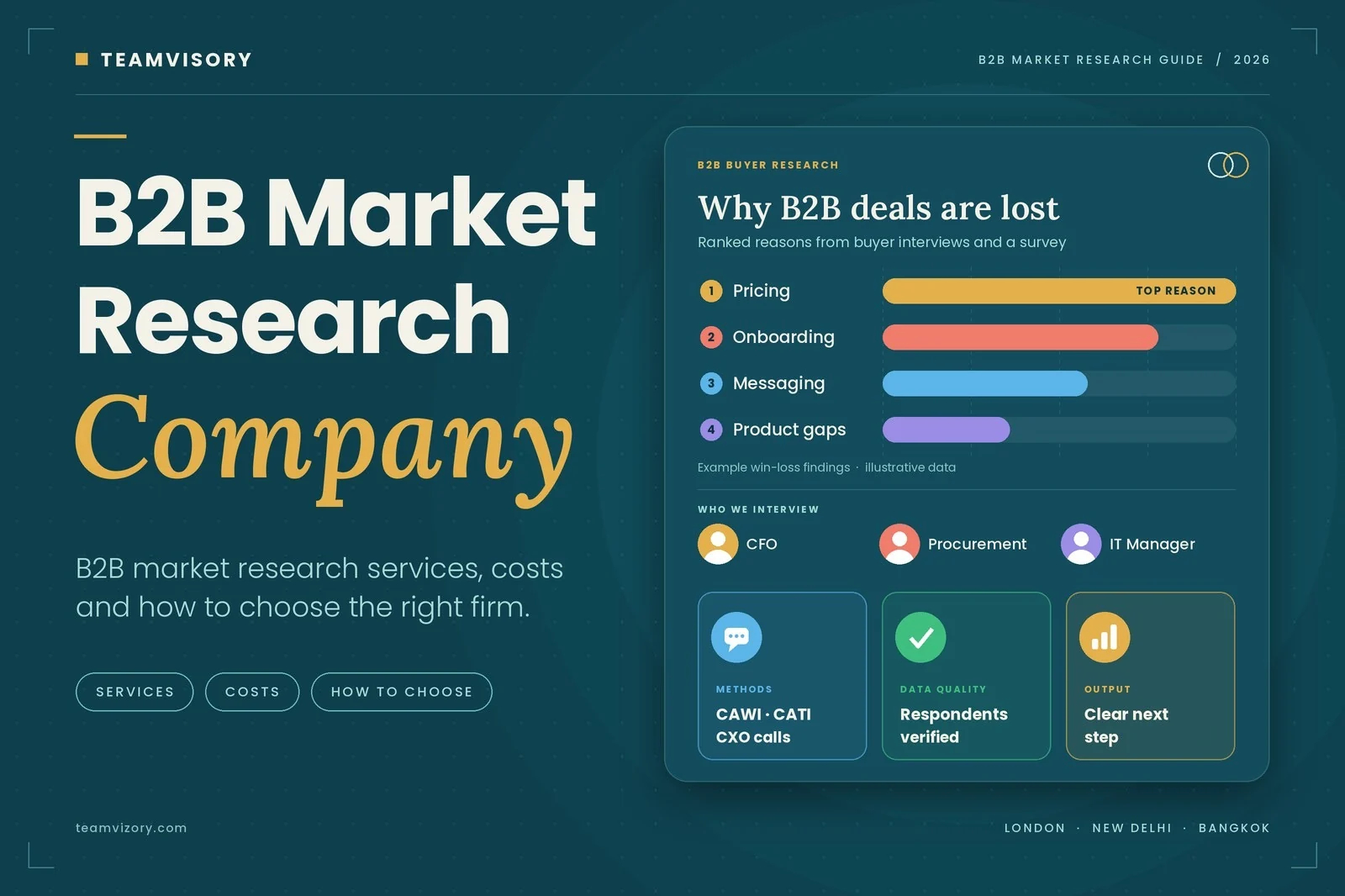
A research partner interviews recent buyers and lost prospects to hear the real reasons. Then a short survey goes to a wider group to see which reasons come up most. The company ends up with a ranked list of why it loses, direct quotes from buyers, and clear changes to make in pricing, onboarding or messaging.
How many people should you interview or survey?
There's no magic number, but these ranges are a sensible starting point. They are general industry guidance, so treat them as a guide, not a rule.
| Study type | Typical starting point |
|---|---|
| Interviews with one buyer group | 8 to 15 interviews, until the same themes keep repeating |
| Online survey, one audience | Around 100 to 300 completed responses |
| Survey comparing several segments | More responses, so each segment has enough people to compare |
| Expert interviews to learn a new industry | A small set of well-chosen experts, often 5 to 10 |
A small sample of the right people beats a large sample of the wrong ones.
How much does B2B market research cost?
There's no standard price. Be careful with anyone who quotes one before they've heard your brief.
A short online survey with a broad business audience sits at the low end. Interviews with senior or niche decision makers in several countries sit at the high end. Six things move the number the most:
- Who you need to reach. Senior or niche roles in small industries cost more than broad roles in common ones.
- Method. An online survey costs less than in-depth or phone interviews.
- Sample size. More respondents, or more segments to compare, means a bigger bill.
- Countries and languages. Each one adds work.
- Timeline. Rush jobs cost more.
- Reporting. Data tables are cheaper than a full report with advice and a presentation.
How to compare two quotes
Two quotes can look the same and still be very different. Check these before you decide:
- Do both quotes cover the same audience, in the same countries?
- Is the sample size the same?
- Does each one say what is included in recruitment, fieldwork, analysis and reporting?
- Does each one list what is not included?
- Is the timeline broken down by stage?
Want a quote for your project? Send us your research question, your audience and the countries you need. We'll suggest a method and share an itemised quote. Request a quote
What to put in your brief:
- The decision you need to make
- Who you want to reach (job titles, industries, company sizes)
- Countries and languages
- Your deadline
- Any past research or data you already have
8 questions to ask before you hire a B2B market research company
Ask every company the same questions. Clear answers are a good sign. Vague ones aren't.
| Question | A good answer | A red flag |
|---|---|---|
| 1. Who exactly will you speak to? | Job titles, industries and company sizes | "Business decision makers" and nothing more |
| 2. Where do your respondents come from? | Names the panel or partners and explains how people are recruited | Silence, or "our network" |
| 3. How do you check data quality? | Identity checks, duplicate removal, checks for rushed answers | "We clean the data" |
| 4. Have you worked in my industry and region? | Relevant examples and local fieldwork | Generic claims with no examples |
| 5. Why is this method right for my question? | Links the method to your decision | The same method for every brief |
| 6. What will I receive? | A data file, a report and a call to walk through findings | A slide deck alone |
| 7. How long will it take, and what could cause delays? | A timeline by stage, with risks named | One date and no detail |
| 8. What's the full price? | An itemised quote that lists exclusions | One lump sum |
The ESOMAR 37 Questions are another handy checklist for anyone comparing B2B research companies. They work well alongside this list.
How TeamVisory helps
TeamVisory is a market research company in India. We started in 2021 and work from London, New Delhi and Bangkok. Each person on our core team has 13 to 30 years of research experience, across FMCG, pharma, and B2B and B2C research.
For B2B work, we run online surveys (CAWI), phone interviews (CATI), expert interviews, CXO-level consultations, channel partner interviews and healthcare professional research.
We reach respondents through our global panel of about 2 million members across Asia, North America, Europe, Australia and New Zealand, the Middle East and Africa. When a role is hard to reach, we recruit directly.
You can read more about our quantitative and qualitative research, online panel research and B2B market research services. If you need fieldwork in India, see our market research company in India page.
How we check data quality
- We check recruited respondents against LinkedIn, Hoovers, official email IDs and phone calls.
- We flag speeders, so rushed answers don't end up in your data.
- We use CAPTCHA, link hash checks, geo IP validation and device fingerprinting to block bots and duplicate respondents.
- On full-service projects, we also add red-herring questions, straight-lining flags and open-end validation.
TeamVisory is an ESOMAR corporate member, a member of the Market Research Society of India (MRSI) and Quirk Certified. We've also answered the ESOMAR 37 questions for buyers, so you can check how we work before you speak to us: ESOMAR 37 Questions (PDF).
Talk to a B2B research team
Not sure which method fits your question? Tell us what you need to answer. We'll suggest a method and a sample, and send you a clear quote.
- Phone: +91 11 46509717
- Email: support@teamvizory.com
- Office: A4 Sector 19, Dwarka, New Delhi-110075, India
- Request a quote: Contact page
- Learn more first: Company profile (PDF) and B2B and B2C Panel Book (PDF)
Frequently Asked Questions
It plans and runs studies with business buyers, then turns the results into advice. That covers finding respondents, running surveys or interviews, checking data quality and writing the report.
It depends on who you need to reach, the method, the sample size, the number of countries and languages, your timeline, and how much reporting you want. Senior or niche audiences cost more than broad ones, and interviews cost more than online surveys. Ask for an itemised quote that lists what is and isn't included.
A firm usually runs the whole project, often with its own panel and fieldwork team. An agency is typically smaller and faster, and sometimes has a marketing focus. Consultants add strategy but may outsource fieldwork. The label matters less than who runs your fieldwork, how respondents are found, and what you get at the end.
Market research collects new information by asking real people questions in surveys or interviews. B2B market intelligence tracks competitors, pricing, news and trends over time using sources that already exist. B2B market analysis works through data to size a market. Use intelligence and analysis to see what's happening, and research to find out why.
It depends on the method and on how hard your audience is to reach. As a rough guide, an online survey with a broad business audience can take a few weeks. Interview programmes with senior or niche people usually take longer because of recruiting and scheduling. Ask any provider for a timeline by stage, with the risks named.
Ask each one the same questions. Who will they speak to? Where do respondents come from? How do they check data quality? Have they worked in your industry and region? What does the full price include? Choose clear, specific answers and an itemised quote over a long client list.
It depends on your question. As a rough guide, qualitative studies often use 8 to 15 interviews per buyer group, until the same themes keep coming up. B2B surveys often start at around 100 to 300 completed responses, and you'll need more if you want to compare several segments. Share your question and audience, and we'll suggest a sample.
Yes. A smaller business can run a focused study, such as 10 to 15 buyer interviews or a short survey, to answer one decision instead of paying for a big programme. Start with the decision you need to make, then size the study to fit it.
 Healthcare Market Research Companies in India: How to Choose One
 Market Research for Starting a Business: What to Do Before You Invest
 Market Research Company in India: A Global Agency's Guide to Fieldwork