

Starting a business often means making important decisions without having all the answers. You may have a strong idea and plenty of market data, but that doesn’t always mean you understand what customers really want. That’s where market research becomes valuable. By looking at customer needs, competitors, market demand and changing trends, startups can make more informed decisions before investing heavily in a new product or market. A reliable market research company in India can help turn this information into practical insights that support smarter business decisions and sustainable growth.
Market research isn’t just something startups do to check a box before launching a new product or service. These days, a good market research company in India does a lot more. It helps founders actually understand how customers think, tighten up internal operations, and figure out which segments are worth betting on. It does not matter if you’re building in B2B SaaS, fintech, healthcare, or consumer tech; the underlying job of research stays the same: replace guesswork with something closer to certainty.
Why Startups Need Market Research Before Scaling?
There was a time when ‘we’ll figure it out as we go” was an acceptable strategy for early-stage founders. That window has narrowed considerably. India’s startup ecosystem is crowded, capital is more selective than it was a few years ago, and customers have far more choices than before.
B2B market research isn’t about drowning a startup in spreadsheets and data dashboards. It's about answering a small number of questions with real conviction:
- Who actually needs this?
- What will make them choose it over what they’re already using?
- What price feels fair to them, not just profitable to us?
A good research partner doesn’t just hand over the answers. They help founders and teams ask better questions to solve greater problems. Here’s why B2B market research companies in India are significant for ambitious startups:
The Comfort of Assumptions is Expensive
Research doesn't eliminate all risk. It just makes sure the risks you're taking are the ones worth taking, not the ones you could have caught early with a few honest conversations.
Investors Have Started Asking the Same Question You Should Be
Capital used to chase vision. Increasingly, it chases evidence of vision meeting reality. Founders walking into fundraising conversations with real customer insight, not just a strong narrative, tend to have shorter, easier conversations. It's not that investors don't believe in ideas anymore. It's that they've seen too many good ideas built on assumptions nobody checked.
Every Wrong Guess Costs More Than the Research Would Have
A mispriced product, a feature nobody asked for, a segment that loved the demo but never had the budget to buy, these mistakes are rarely fatal on their own, but they add up in time, money, and morale. Research doesn't eliminate all risk. It just makes sure the risks you're taking are the ones worth taking, not the ones you could have caught early with a few honest conversations.
What Does a Market Research Company in India Do
A market research company helps businesses understand what is happening outside their own organisation. For a startup, this can be especially useful because many early decisions are based on assumptions about customers, competitors and demand.
The research can start with something as simple as understanding who the potential customers are and what they actually need. From there, the research team may look at competitors, market size, customer segments, pricing, product preferences and buying behaviour. The goal is not just to collect more data, but to find information that can help the business make a better decision.
Depending on the research objective, a market research company may use different approaches. Qualitative research can help uncover the reasons behind customer opinions and behaviour, while quantitative research can show broader patterns across a larger group of respondents. Online panel research can also be used when a business needs feedback from a specific target audience.
For example, a startup planning to launch a new product may want to know whether customers actually see a need for it, what they currently use instead, how they feel about the proposed price and what could stop them from buying. Research can bring these questions to the surface before the company spends heavily on the launch.
This is where choosing the right market research company in India matters. The value is not simply in collecting responses. It is in asking the right questions, reaching the right people and turning the findings into insights that a business can actually use.
What to Look for in a Market Research Company in India
Choosing a market research company is not just about finding a team with a long list of services. For a startup, it is more important to find a research partner that understands the business question, knows how to reach the right audience and can turn the findings into something useful.
Here are a few things worth considering before choosing a market research company in India:
- Relevant Industry Experience
Industry experience can make the research process smoother, especially when the team already understands the market, customer behaviour and common challenges in your sector. At the same time, the research team should be open to questioning assumptions instead of simply confirming what you already believe.
- The Right Research Methodology
Not every business question needs the same type of research. Depending on your objective, you may need qualitative interviews, quantitative surveys, online panel research, panel research or a combination of different methods. A good research partner should be able to recommend an approach based on what you are trying to find out.
- Access to the Right Respondents
Good research depends heavily on reaching the right people. Before starting a study, look at how the research company sources and screens respondents and whether they can reach the audience you actually want to study.
For example, researching business decision-makers requires a very different audience from researching consumers in a particular age group or location.
- Data Quality
A large number of responses does not automatically mean better research. The quality of the sample, respondent screening, questionnaire design and data checks all matter. A reliable research company should have a clear process for maintaining data quality throughout the study.
- Geographic Reach
If your startup is targeting customers across different cities, regions or countries, make sure the research partner can support the locations you need. This becomes particularly important when customer behaviour varies significantly from one market to another.
- Clear and Actionable Reporting
A research report should do more than present pages of charts and numbers. The findings should make it easier for your team to understand what customers are saying, where the opportunities are and what the research means for your next decision.
The best reports are easy to follow and connect the research findings with the original business question.
- Flexibility to Match Your Research Needs
Startups often do not have the same research requirements as large enterprises. Your research needs may change as you learn more about the market. It helps to work with a research company that can adapt the scope, audience or methodology when the project requires it.
Ultimately, the right market research company in India should not just provide data. It should help you understand what that data means for your business and give you a clearer basis for making decisions
How Different Market Research Methods Work Together?
Different research methods can be used together depending on the business question. Qualitative research can help explore the reasons behind customer behaviour, while online panel and quantitative research can help test those findings with a broader audience.
-
Start with Qualitative Research to understand the underlying "why" behind a problem or opportunity.
-
Move to Online Panel Research to get a fast directional read on whether that insight holds across a broader, well-defined audience.
-
Finish with Quantitative Research to validate the finding with statistical confidence before committing resources.
Startups that treat research as this kind of layered process, rather than a one-off survey before a launch, tend to make fewer costly pivots later.
When Should a Startup Conduct Market Research?
Market research is not something startups should think about only when they are ready to launch. It can be useful at different stages of the business, especially when an important decision needs to be made. The right time to conduct research depends on what you are trying to understand or validate.
Before Launching a Product
Before investing time and money into a new product, it helps to know whether there is a real need for it. Research can help you understand your target customers, their problems, existing alternatives and what they expect from a product like yours.
Before Entering a New Market
A product that works well in one market may not get the same response somewhere else. Before entering a new city, region or country, market research can help you understand local customer preferences, competitors, demand and potential challenges.
Before Changing Your Pricing
Pricing decisions can have a direct impact on sales and customer perception. If you are planning to increase your prices, introduce a new pricing model or target a different customer segment, research can help you understand how customers may respond.
Before Expanding to a New Customer Segment
Your existing customers may not have the same needs as a new audience. Research can help you understand whether the new segment has a genuine need for your product, what influences its buying decisions and how your offering may need to change.
In simple terms, startups do not need to wait for a problem before conducting market research. Whenever a major business decision involves uncertainty, research can help replace assumptions with a clearer understanding of the market.
The Quiet Advantage of Getting This Right Early
None of this guarantees success. No research study can substitute for a good product, a capable team, or reasonable timing. What it does is reduce the number of expensive guesses a startup makes along the way. The founders who make the most from B2B market research aren't the ones who commission the most studies. They're the ones who ask precise questions, choose the right method for the right stage, and stay honest about what the data is actually telling them.
In a market as dynamic and competitive as India's, that kind of clarity isn't a luxury. It's often the quiet difference between a startup that adapts early and one that finds out too late.
Frequently Asked Questions
A market research company helps businesses learn more about their customers, competitors, and the market before making important decisions.
It helps startups understand what customers want, check whether an idea has demand, and spot competitors before spending heavily on growth.
It can help with customer research, competitor analysis, surveys, interviews, product testing, pricing research, and online panel studies.
It depends on the research goal. Startups commonly use qualitative research, quantitative research, and online panel research.
There is no fixed cost. It usually depends on the research method, number of respondents, target audience, locations, and project scope.
Look for a company that understands your industry, can reach the right audience, uses suitable research methods, and provides findings that are easy to understand and use.
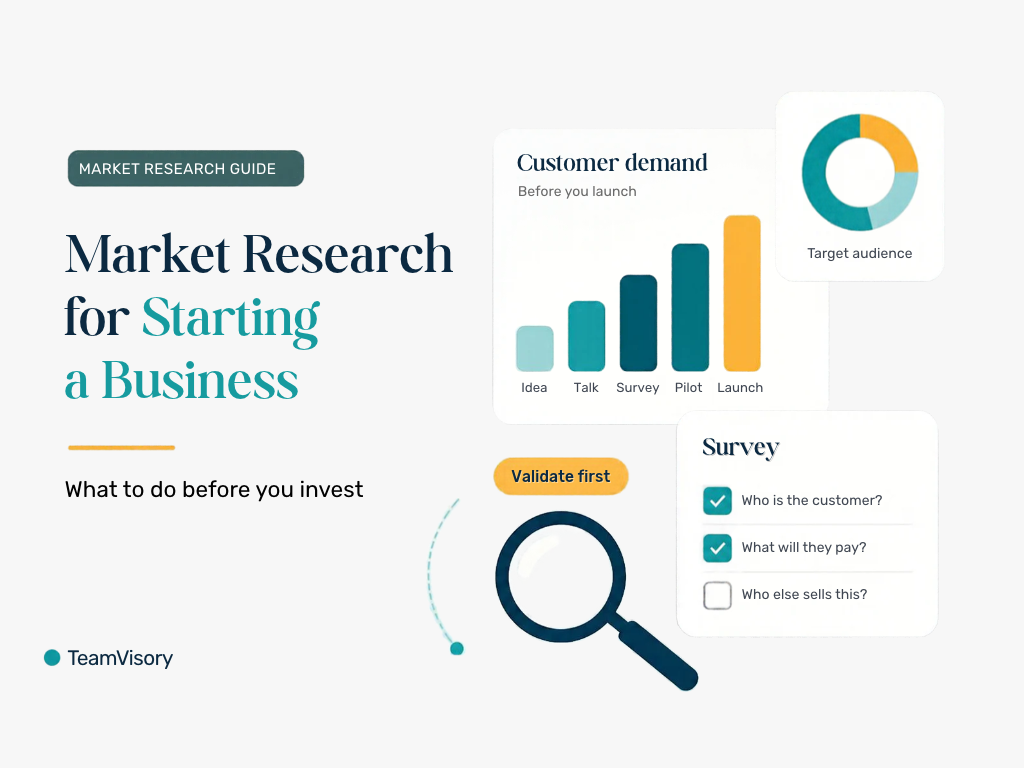 Market Research for Starting a Business: What to Do Before You Invest
  Market Research in the Pharmaceutical Industry: How Pharma Companies Use It
  International Market Research Fieldwork: A Complete Guide for Multi-Country Studies