Most bad business decisions don’t feel bad at the time. The price seemed fair. The pack looked great in the office. The feature list matched what the sales team kept asking for. Then the product launches and nobody buys it.
Market research is how you catch that gap early. A market research company in Delhi does it by talking to the people you want as customers, measuring what they say and do, and giving you findings you can act on.
But agencies aren’t all alike. This guide covers what they do, how to compare them, what pushes the price up or down, and how the work changes across healthcare, FMCG, SaaS and startups.
Quick answer: A market research company in India plans and runs studies, such as surveys, interviews, focus groups and online panels, to find out what customers want, how competitors compare and whether an idea is likely to work. You get a report with findings and recommendations. Many serve all of Delhi NCR and the rest of India, and some run studies across several countries.
Why research matters in Delhi NCR
On a map, Delhi NCR looks like one market. It isn’t. People in Greater Kailash, Gurugram, Noida and Old Delhi can differ in income, language, shopping habits and which brands they trust. A message that works in one area can fall flat a few Metro stops away.
Research helps you answer plain questions:
• Who is actually buying, and why?
• Why do customers pick a competitor?
• Is the price too high, or too low?
• Will people understand this product or pack?
• Is there enough demand in a new segment to justify entering it?
Teams that live with a product every day can’t easily answer these from the inside. Research gives you the view from outside.
One catch. A study run only in Delhi NCR tells you about Delhi NCR. If you’re planning a national launch, say so at the start so the sample is built to match.
What does a market research company in Delhi do?
In short, it helps you answer a business question with evidence instead of opinion. These are the main tools.
Consumer and customer research
This is the study of who buys, why they buy, how they use a product and what they think of your brand.
Imagine a tea brand whose repeat purchases have dropped. Sales figures show the drop but not the reason. Speaking to people who stopped buying might point to taste, price or pack size. You only find out by asking.
Qualitative and quantitative research
Qualitative research means deep conversations with a small number of people: interviews, focus groups, sometimes observation. It tells you why. Quantitative research means structured surveys with many more people. It tells you how many.
Real projects often use both. Talk to people first, then run a survey to see how widespread what you heard really is.
Online panel research and surveys
An online panel is a pool of people who have signed up and been profiled to take part in surveys. Instead of hunting for respondents one by one, an agency picks them from the panel by age, city, job or buying habits.
That helps most when your audience is narrow, say IT managers at mid-sized companies. Online panel research is only as good as the panel’s quality checks, though, so ask how duplicates and rushed answers get caught.
Competitor and market assessment
This mixes published information with fresh interviews or surveys to show how rivals price and position themselves, and where the market is heading. The aim isn’t to copy anyone. It’s to spot the gaps nobody is filling.
Product testing and concept validation
Before launch, you show a product, pack, feature or message to your target audience and measure interest, preference, purchase intent and reaction to price. A weak idea is cheaper to fix on paper than on a shelf.
How to choose among market research agencies in Delhi
Every proposal looks polished. Here’s what separates good market research agencies in Delhi from the rest once you look closer.
- Experience in your sector. Ask what they’ve done in your field and ask for something you can verify. Healthcare research and snack research are different jobs.
- A method that fits your question. Be wary if every brief gets the same survey.
- Who they’ll actually talk to. Specialist doctors, senior buyers and niche product users are hard to find. Ask how, and what happens if recruitment drags.
- How they deal with bad data. Duplicate, fake and rushed responses exist in every survey. Ask how they’re caught. It’s also worth checking whether the agency publishes its answers to ESOMAR’s 37 Questions, a standard list that buyers can use to compare research providers.
- What the report looks like. Ask for a sample with client details removed. Good reports end in recommendations, not just charts.
- Privacy and consent. Ask how consent is taken and how respondent data is stored. This matters most in healthcare.
- Who runs the project. Find out who you’ll deal with day to day, and what the timeline looks like.
A few red flags: promises of guaranteed results, a quote that arrives without a single question about your business, and a very low price with a vague scope.

Market research firms in Delhi: how to compare them
You’ll see agency and firm used as if they’re different things. In practice they mostly aren’t. “Agency” tends to mean a company that runs fieldwork and collects data. “Firm” often means one that also does consulting. The labels aren’t standard, so judge by what the company delivers.
You’ll also find lists of the top market research companies in Delhi. Use them to collect names, nothing more. Ranking criteria are often unclear, and a list can’t tell you whether a company fits your project.
A better test is to give two or three shortlisted market research firms in Delhi the same one-page brief. Cover the decision you need to make, who you need to reach, where, and your timeline and rough budget. Then compare what comes back:
• How well they understood the problem
• The method they propose and their reason for it
• Sample size, audience and recruitment plan
• What you’ll receive: a report, data tables, raw data, a presentation
• Timeline, and what could delay it
• Total cost, and what’s left out
The cheapest quote often has something missing: a smaller sample, no analysis, a thinner report. Make sure you’re comparing like with like.
Industry-specific market research in Delhi NCR
A questionnaire for a hospital group looks nothing like one for a snack brand. Knowing the sector changes the questions, the respondents and how the results are read.
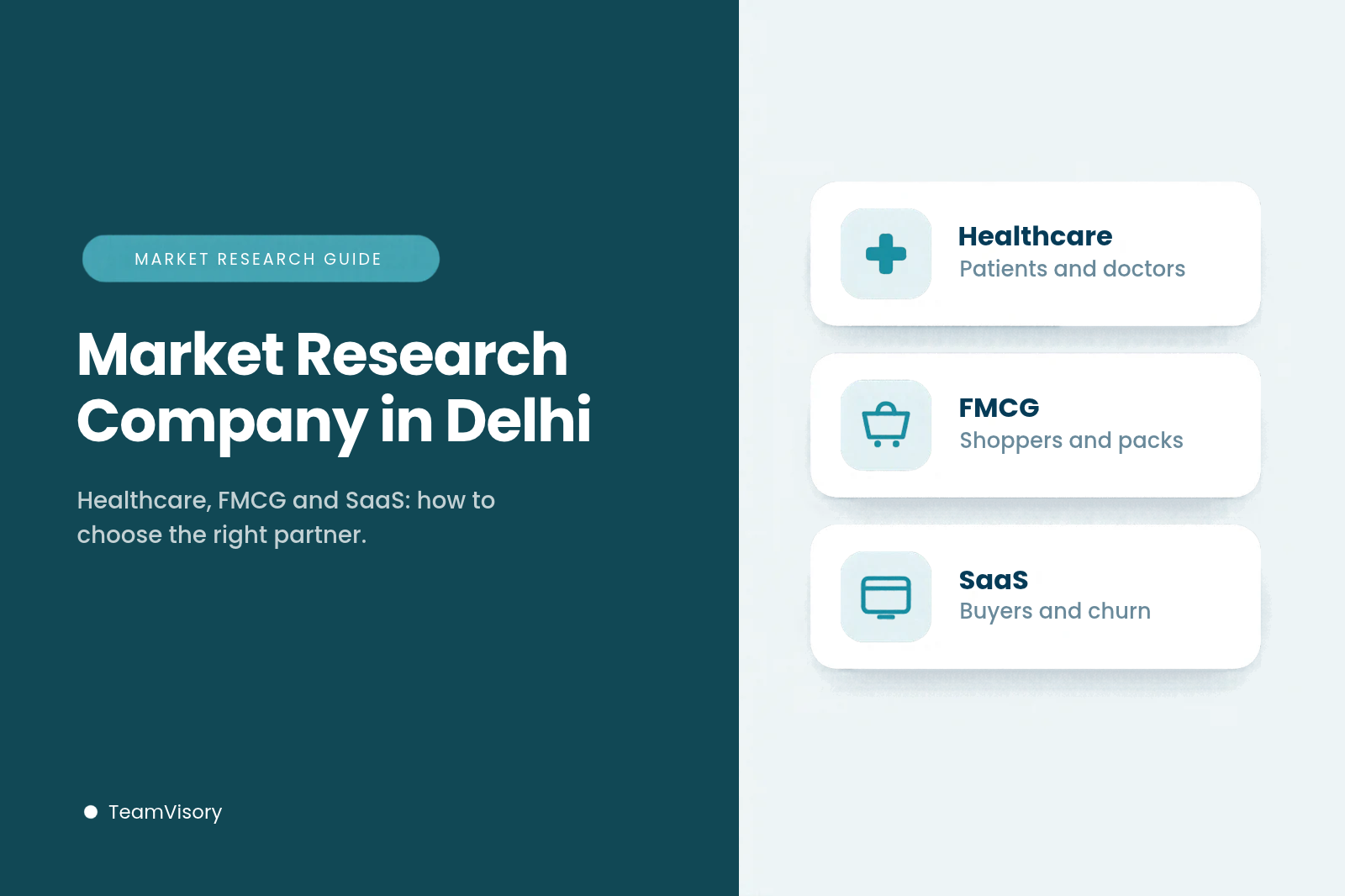
Healthcare and pharmaceutical research
These studies involve patients, doctors, nurses, pharmacists and sometimes payers. Typical topics are patient journeys, how doctors choose between treatments, awareness of a therapy, and how a service is rated.
Extra care is needed here. Consent, confidentiality and applicable research rules matter more than in a consumer study, and respondents should be verified as genuine patients or professionals. TeamVisory’s healthcare market research combines primary research (surveys, interviews, panels) with secondary research from published sources.
FMCG and consumer goods research
In FMCG, a lot of similar products compete for a few seconds of a shopper’s attention. Research here looks at preferences, price sensitivity, packaging feedback, purchase behaviour and what happens in stores. A simple example: showing two pack designs to target shoppers before you print.
SaaS and B2B research
Software founders often skip research because they think they already know the customer. Stalled deals, weak adoption and churn are usually signs they don’t.
Useful studies include buyer interviews, product-market fit checks, feature prioritisation, competitor positioning and research into why customers leave. Interviews with former customers, for instance, can show whether they left over price, a missing feature or a bad start with the product. Each needs a different fix. B2B audiences are harder to reach, so define them by job role, seniority, industry and company size.
Market research for startups
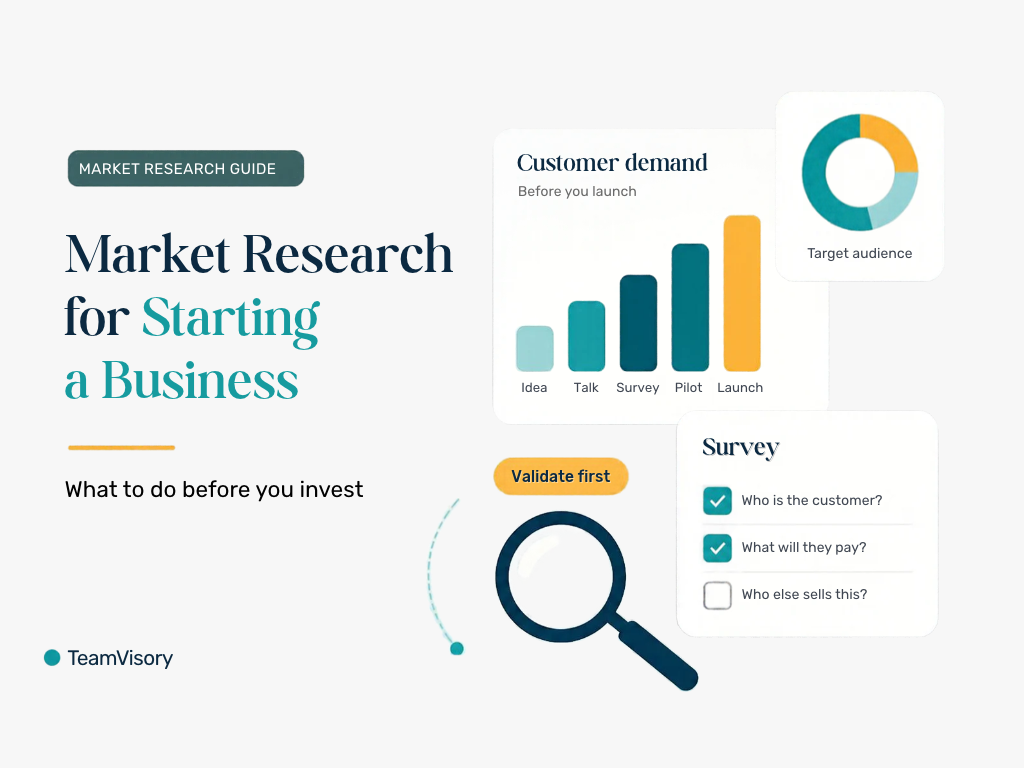
A startup rarely needs a big study. It needs honest answers to a few questions. Is the problem real? Who has it? Would they pay for a fix?
A small round of interviews can test early assumptions cheaply. A survey can then check how far the interest stretches. Concept testing helps you pick between ideas before you build. Research can’t guarantee success, but it can show you weak assumptions early.
How much do market research services in Delhi cost?
There’s no honest single price, and anyone who quotes one without understanding your project should make you cautious. What moves the cost:
• Method. Interviews and focus groups are priced differently from online surveys.
• Sample size. More respondents means more fieldwork and analysis.
• Audience. General consumers are cheaper to reach than specialist doctors or senior decision-makers.
• Geography. One city costs less than several cities or countries.
• Recruitment difficulty. Niche audiences take longer to find.
• Analysis. Segmentation or pricing models need more specialist time.
• Reporting. A short summary costs less than a full report with a presentation.
To keep costs sensible, write a clear brief, ask for a quote that lists what’s included and what isn’t, and consider a smaller first phase before committing to a large study.
Why consider TeamVisory for market research?
TeamVisory is a market research company based in Dwarka, New Delhi. Its work covers:
• Qualitative research: in-depth interviews, focus groups, ethnographic studies and thematic analysis.
• Quantitative research: survey design, market sizing, customer satisfaction, product and concept testing, pricing research and brand tracking.
• Online panel research: B2B and B2C respondents, targeted recruitment, and quality checks such as Geo-IP validation and CAPTCHA screening.
• Healthcare market research: primary and secondary research involving patients and physicians, using methods such as CATI and CAWI.
• Multi-country studies: coordinated across markets, with local audiences and languages in mind.
It supports healthcare and life sciences, consumer and FMCG, technology and SaaS, B2B and professional services, and retail. Its answers to ESOMAR’s 37 Questions are published on the site, so you can check its standards before you talk to anyone.
The questions it helps with are practical ones. Should we launch this? Why do customers choose a competitor? Is our price right? Which audience comes next? It starts from the decision you need to make, then picks the method, and most studies combine more than one.
Which market research company in Delhi is right for you?
The right market research company in Delhi is the one that understands the decision in front of you, picks a method to match, and is open about how its data is collected. Look at experience, sampling, reporting and privacy. Compare firms on the same brief, not on a ranking.
If you’re weighing a launch, a pricing change or a new segment, talk to the TeamVisory team about what research is worth doing. Start with the question you need answered.
Frequently asked questions
Begin with the decision you need to make, not the method. Shortlist companies that have worked in your sector, then give each the same brief and compare proposals. Look at who they’ll interview, how they check data quality, what the report includes and how long it takes. Price matters, but make it the last filter, not the first.
Most run surveys, in-depth interviews, focus groups and online panel studies. Many also do competitor assessments, product and concept testing, pricing research and brand tracking. Some focus on one sector, such as healthcare. Check that the agency has run the kind of study you need before you ask for a quote.
Not much, in practice. People tend to use “agency” for companies that run fieldwork and collect data, and “firm” for those that add consulting or strategy. The labels aren’t standardised. Compare what a company actually delivers: methods, audience access, analysis and reporting.
There’s no single official ranking. Lists online use different criteria, and some say little about how they chose. Treat them as a source of names, then judge each company on sector experience, method, data quality and past work you can verify. TeamVisory is one Delhi-based option, but whether it suits you depends on your project.
Any business that sells to customers. Healthcare and pharma, FMCG, retail, technology and SaaS, financial services and education all use it to understand buyers, test ideas and watch competitors. The method changes from sector to sector, but the goal stays the same: fewer decisions made on guesswork.
Yes, within limits. Early interviews can test whether the problem is real and whether people would pay to solve it. A survey can then check how widespread the interest is. Research can’t promise a business will work, but it can expose weak assumptions before you’ve spent much.
Ask who will run the project day to day, how respondents are recruited and checked, what sample size and method they suggest and why, what the final report contains, how personal data is handled, and what the quote doesn’t cover. Ask for case studies or references you can verify.
 Market Research for Starting a Business: What to Do Before You Invest
 Market Research in the Pharmaceutical Industry: How Pharma Companies Use It
 International Market Research Fieldwork: A Complete Guide for Multi-Country Studies